
Story dossier · Character → World → Plot → Story
The Chronicles of Renaissance Scribes
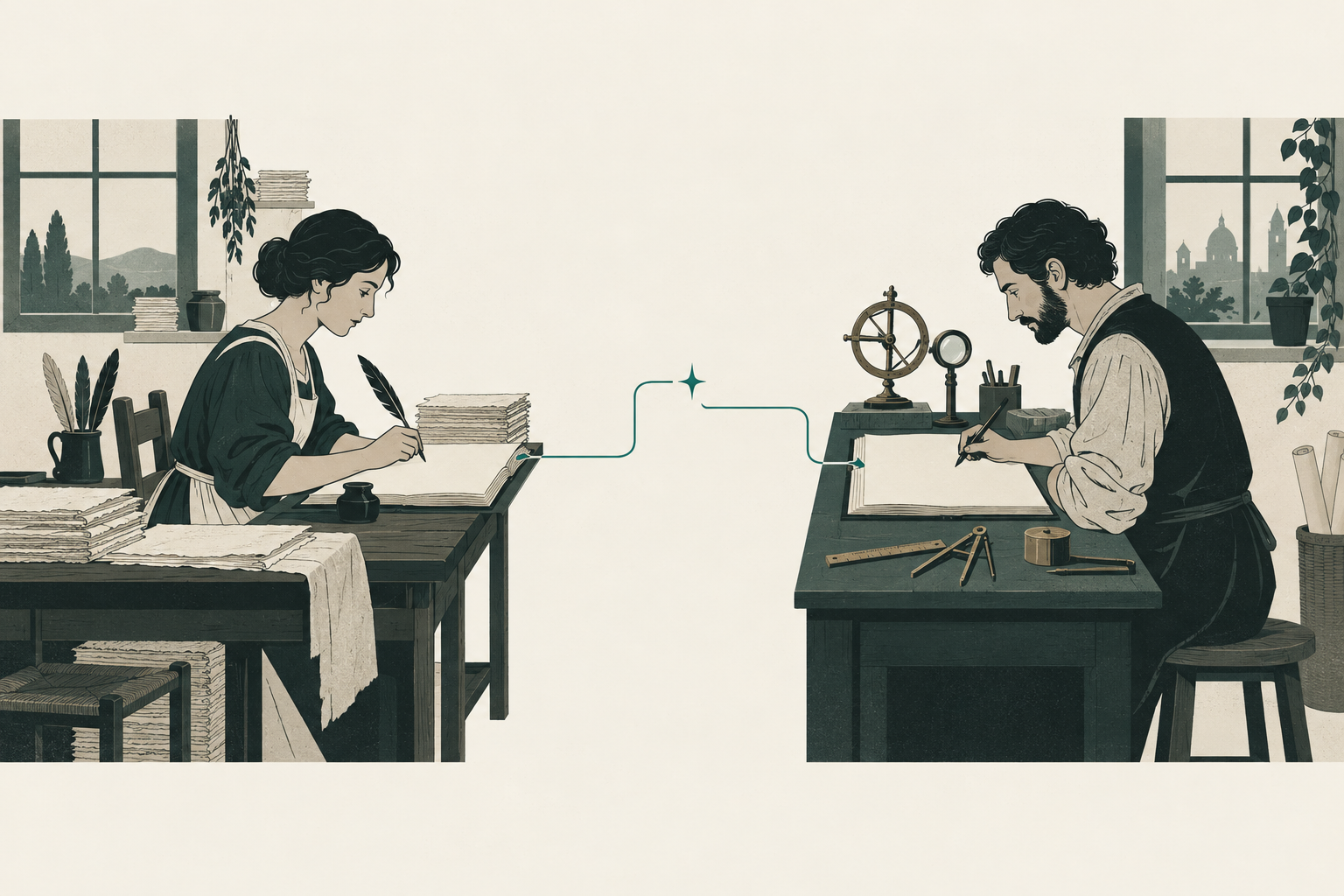
When an apprentice copyist discovers that a Florentine register answers a writer 103 years in the future, she must choose between the clean page that secures her livelihood and the contradiction that can restore people the archive has erased.
Story record
Historical frame
Florence, 1507, and Padua, 1610, under research; speculative archival link.
Reader contract
Quietly tense archival historical fantasy about labor, evidence, patronage, and the cost of making uncertainty visible. The present listing is a lore-length prototype, not the completed novel.
Story context
Synopsis
The current Gumroad edition offers a short historical-fantasy premise involving Renaissance thinkers and a hidden archive. The planned redevelopment uses two historically separated timelines, an original working copyist, constrained paired folios, and a property conflict whose consequences move through the record rather than placing Leonardo da Vinci and Galileo Galilei in one undated room.
The ingredients
These are the exact public records connected to this Story—not suggestions inferred from tags or matching words.
Character
The person whose choices carry the pressure.
Connected record
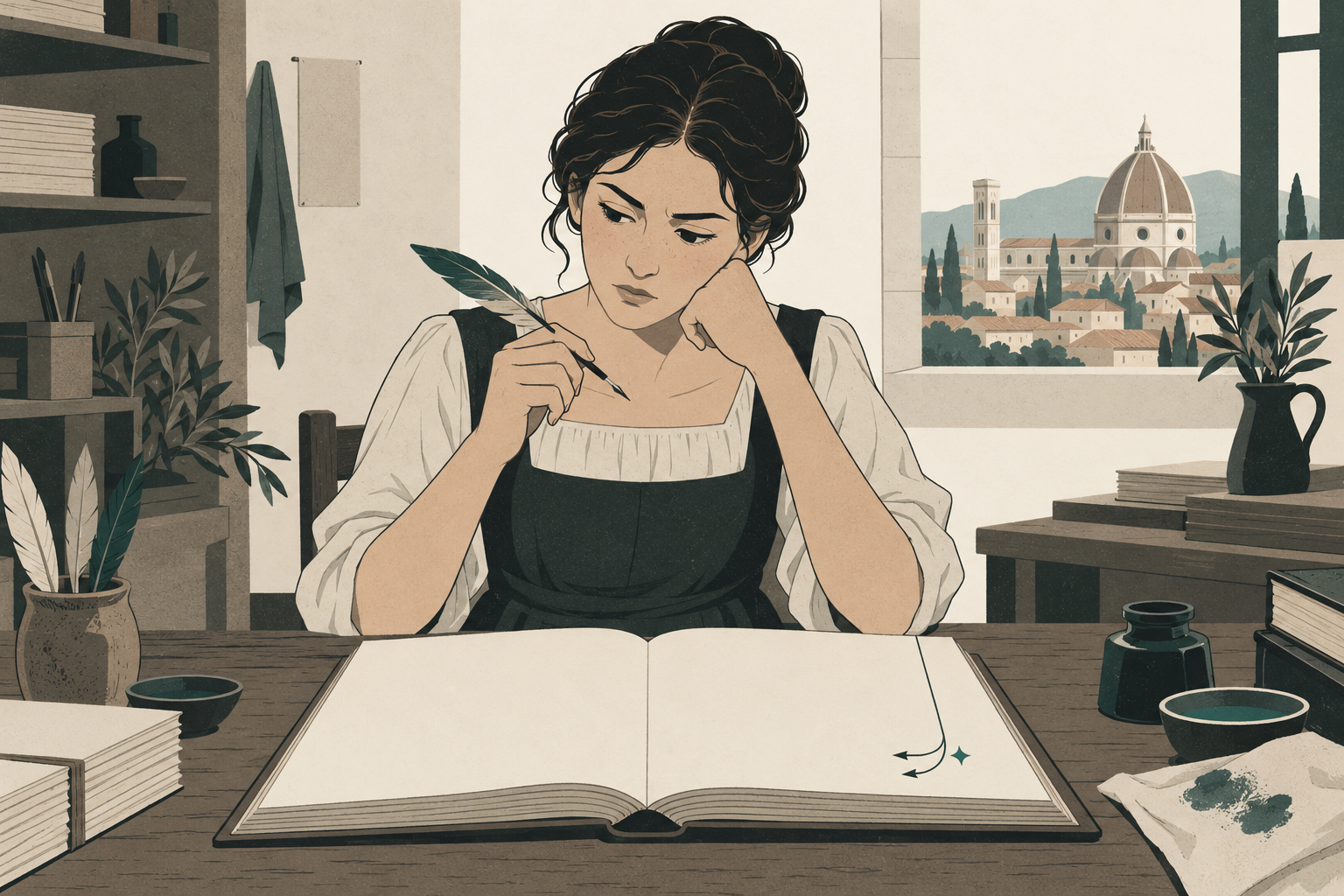
Livia Serrani: Character Record
Meet Livia Serrani, a fictional Florentine copyist whose desire for a secure, flawless record collides with evidence the archive tried to erase.
Open recordWorld
The inhabited system that makes the choice costly.
Connected record
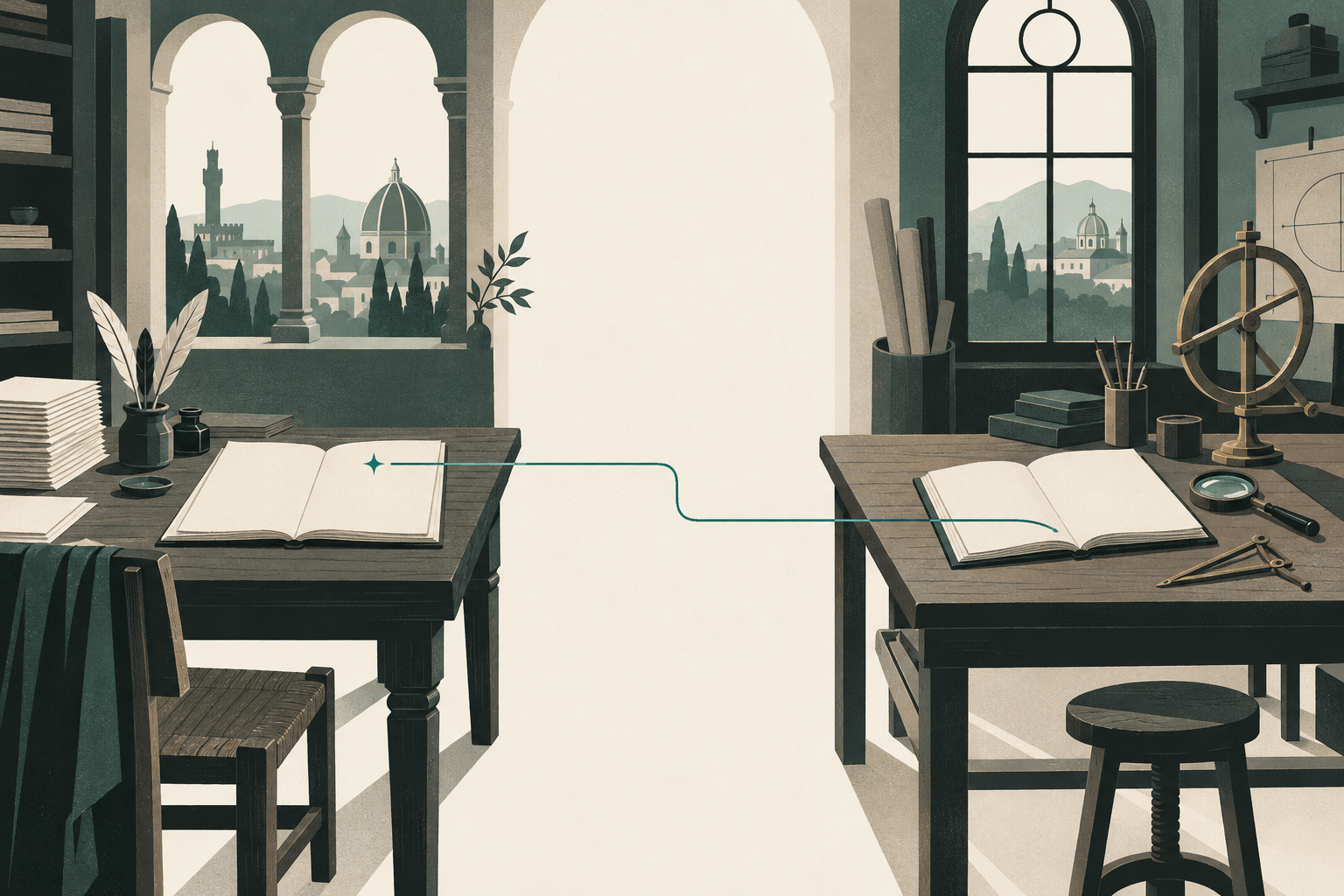
The Two-Dated Archive: World Record
Explore a historical-fantasy world linking Florence in 1507 to Padua in 1610 through scarce marginal ink, physical records, and costly erasure.
Open recordPlot
The causal route that turns pressure into consequence.
Connected record
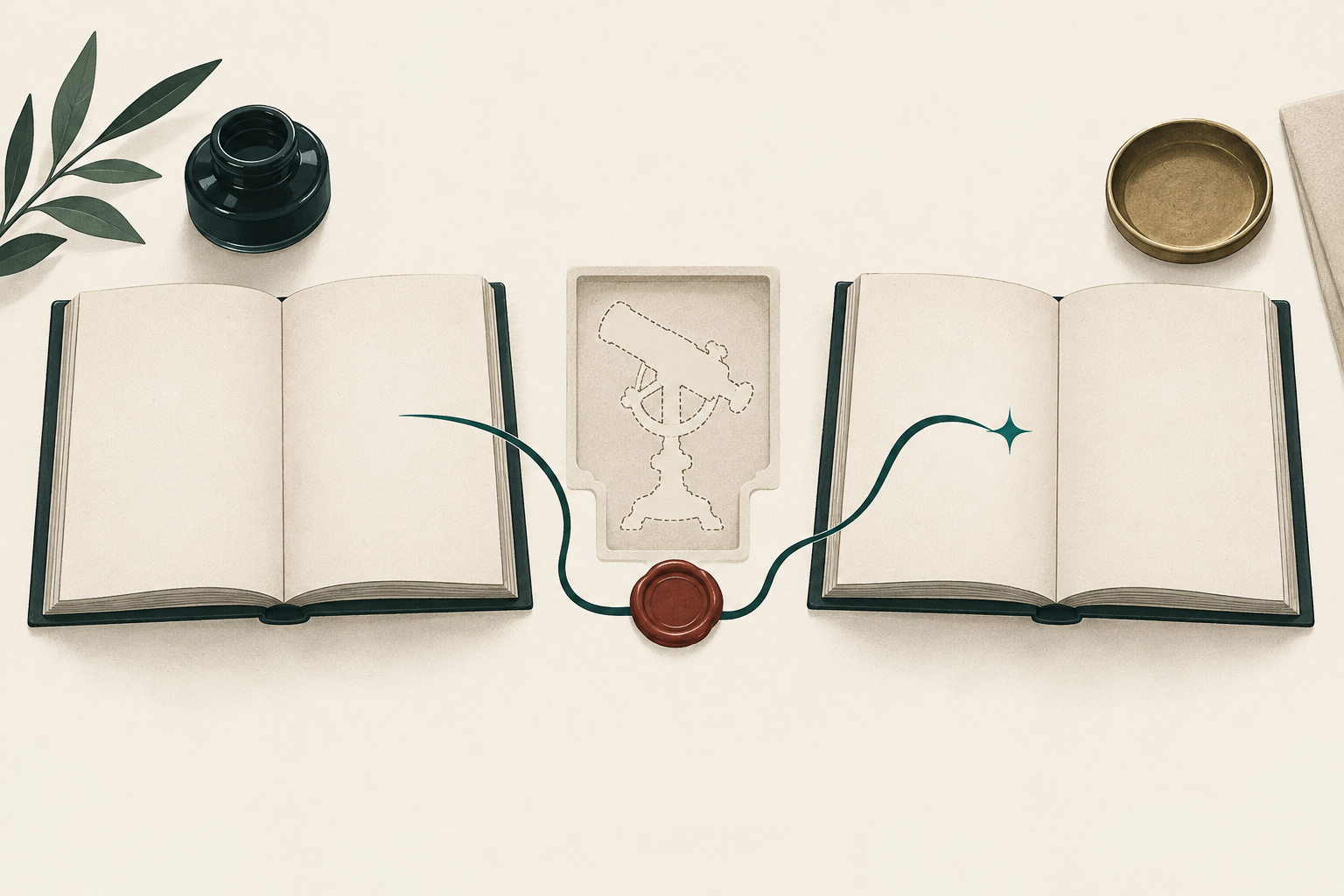
The Register That Writes Back: Plot Record
See how a future warning, a damaged property register, and ordinary receipts form a causal historical-fantasy plot without letting magic solve the case.
Open recordEditions and field notes
Publications
No linked public record is available yet. The route remains open while the dossier is being catalogued.
Field notes

Connected record
How to Build a Historical-Fantasy World from Records, Materials, and Access
Build a historical-fantasy world by mapping materials, access, authority, cost, and one speculative rule, with a practical worked example.
Open record
Connected record
A Plot Structure Example Built with Because/Therefore Causality
Use because/therefore causality to turn a premise into a plot where every choice closes an option and creates the next problem.
Open record
Connected record
What Belongs in a Character Sheet for a Novel?
Build a novel character sheet that tracks goals, conflict, voice, relationships, knowledge, continuity, and change without collecting trivia.
Open record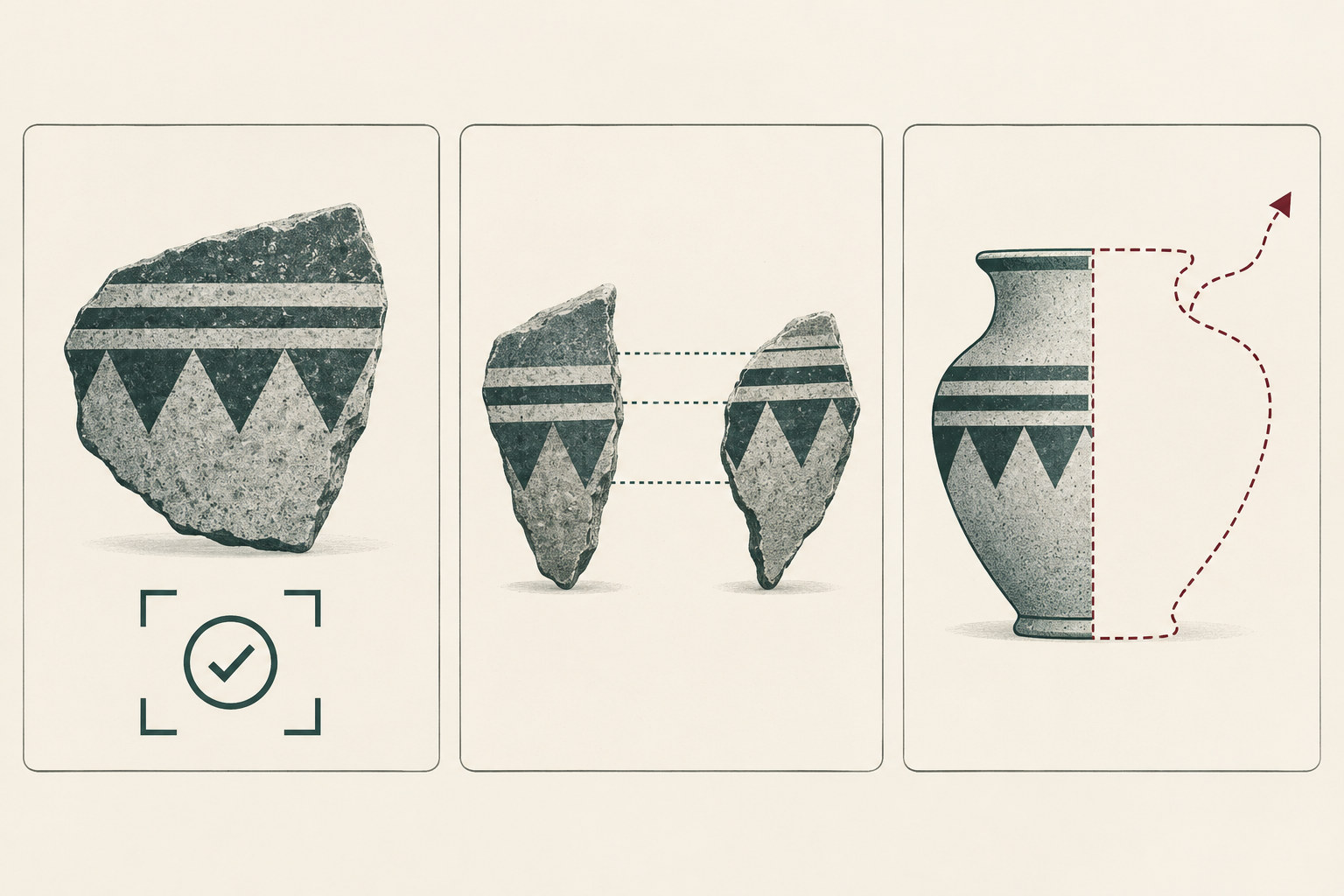
Connected record
How to Separate Historical Fact, Inference, and Invention
Use a claim-level fact, inference, and invention ledger to research historical fantasy honestly without surrendering imaginative freedom.
Open record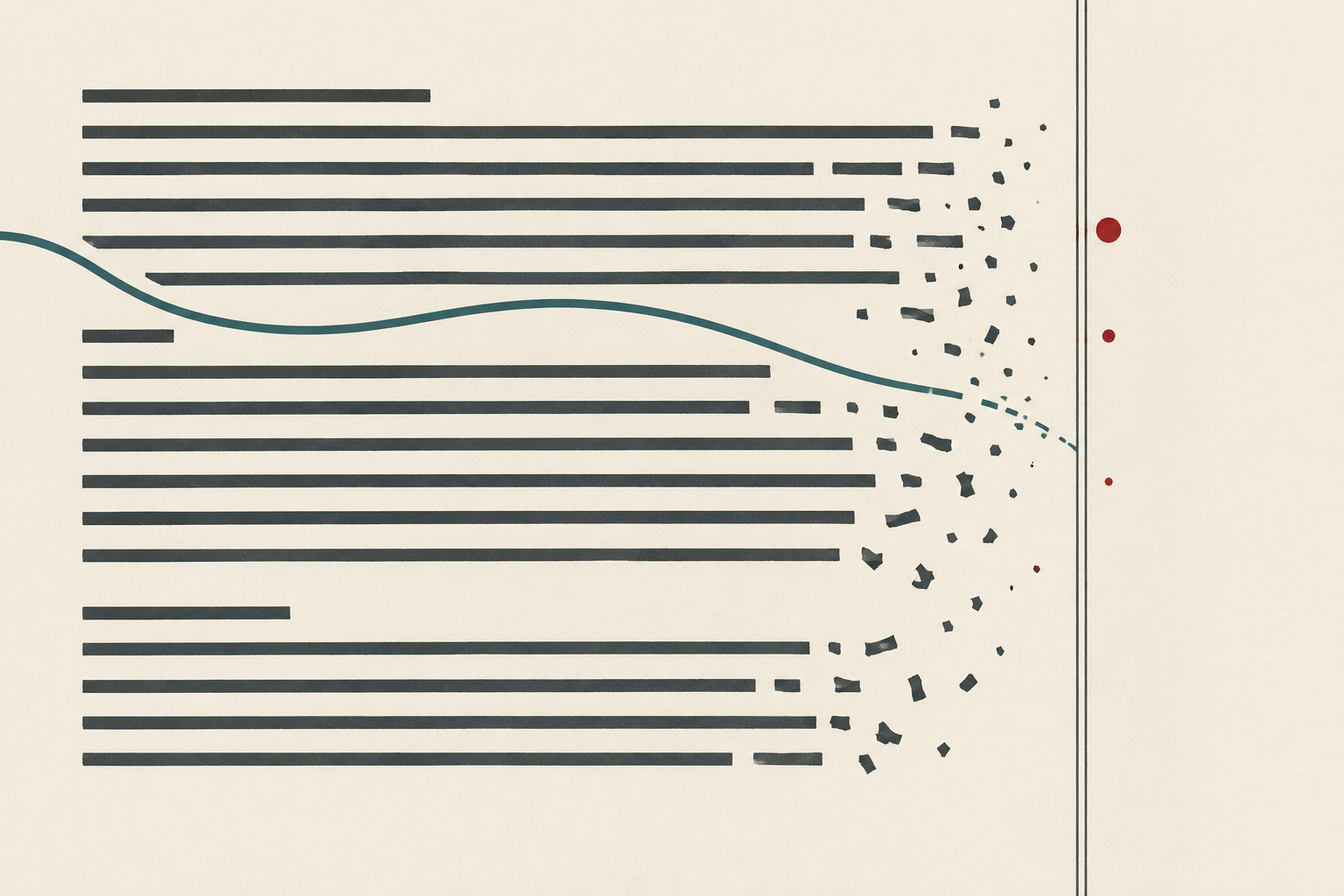
Connected record
Magic with a Cost: Designing Rules That Create Story Choices
Design a fantasy magic system whose channel, limits, access, and cost create difficult character choices instead of convenient solutions.
Open recordRead
The approved public story or excerpt appears here as the canonical WordPress body.
When an apprentice copyist discovers that a Florentine register answers a writer 103 years in the future, she must decide what a truthful record should preserve when certainty is the price of security.
The Chronicles of Renaissance Scribes is being rebuilt as a researched historical-fantasy story about labor, evidence, patronage, and the cost of making uncertainty visible.
The concept currently exists in two different forms that must not be confused:
- an observed 3,267-word lore book associated with the existing Gumroad catalogue; and
- a planned novel-length redevelopment, provisionally scoped at 80,000–95,000 words, for which no completed manuscript is being claimed.
The exact Gumroad URL, files, price, and listing language still require reverification. Until that happens, this page is a story-development dossier rather than a purchase page.
Story status
| Public status | Book in development |
| Current observed edition | 3,267-word lore book |
| Planned redevelopment | Dual-timeline historical-fantasy novel |
| Manuscript status | No completed novel claimed |
| Complete public short story | The Line She Left — ready for WordPress staging |
| Primary dates | Florence, 1507, and Padua, 1610 |
| Historical basis | Documented settings and material culture with invented leads, conflict, and magic |
The story promise
Livia Serrani has built her value around clean work. In a Florentine workshop in 1507, that means repairing a damaged property register before a sensitive review and avoiding the kind of uncertainty a patron can blame on the copyist.
Then an old-looking sentence appears beside a correction she has not made.
The line comes from another folio in Padua in 1610. The pages can exchange fresh marginal ink across exactly 103 years, but the remaining blank space is scarce. Erasing a magical note destroys nearby ordinary writing in both dates.
As Livia tests the page, she finds that the register’s missing names survive elsewhere—in receipts, remembered transactions, and other hands. The future writer needs those discrepancies for reasons of their own. Neither can see the other’s full circumstances, and the page cannot decide which evidence deserves belief.
The result is a quiet historical-fantasy investigation in which the miracle points toward the problem while people, records, and choices carry the proof.
What kind of reading experience is this?
Expect material detail, constrained magic, and tension built from access rather than spectacle. Paper, ink, copying, credit, instruments, storage, and patronage are active parts of the conflict.
The story is interested in a difficult theme: institutions need usable records, yet a page can become dangerously persuasive when all visible disagreement has been removed. It does not argue that uncertainty is automatically virtuous. It asks what responsible uncertainty looks like when delay and ambiguity can also be exploited.
The planned voice is close, restrained, and concrete. It should avoid faux-archaic dialogue, celebrity cameos that solve the problem, generalized “Renaissance” scenery, and magic that overrides ordinary evidence.
The three connected records
Character: Livia Serrani
Livia is a wholly invented apprentice copyist. She wants permanent work and believes a flawless page will make her safe. Her eye for fibers, pressure, corrections, and hands gives her the means to recognize a problem; her dependence on the workshop gives the problem a cost.
Open Livia’s character dossier
World: The Two-Dated Archive
Florence in 1507 and Padua in 1610 remain materially and politically distinct. The linked folios carry only fresh marginal ink. Custody, literacy, daylight, paper, money, and permission determine who can use even that narrow channel.
Plot: The Register That Writes Back
The first impossible warning leads to a controlled test; the test leads to sensitive pages; those pages lead to ordinary counter-records; and the counter-records reveal that a later dispute depends on what Livia does now. The public plot record stops before the final crisis and aftermath.
The historical seam stays visible
The two cities and their dates are real. Florence in 1507 was in a republican interval before the Medici returned in 1512. Padua in 1610 was at the end of Galileo’s long appointment at its university, the year Sidereus Nuncius appeared. The Met: Florence and the Medici · University of Padua: Galileo’s years
The writing materials also have a documented foundation. Iron-gall ink was used across Western manuscript culture for centuries; handmade paper carried mould structure and watermarks; print and handwriting continued to share pages and margins. Library of Congress: iron-gall ink · Library of Congress: watermarks · Folger: technologies of writing
Livia, Bellori, Caterina, the future writer, the property conspiracy, and the paired folios are invented. The project has not yet locked the exact Florentine office, review procedure, woman’s route into paid copying, travel calendar, or 1610 repository. Those are research gates, not gaps to hide with confident prose.
Read the complete concept short story
“The Line She Left” is a complete 2,700-word historical-fantasy prelude in which Livia encounters the first impossible warning, tests the page rather than trusting it, finds an ordinary record that complicates the clean copy, and accepts an immediate professional cost to leave the contradiction visible.
Read “The Line She Left” in full below.
The story is designed to render on this Story page and has passed editorial, continuity, source-boundary, and spoiler review.
It remains a public prelude, not a compressed disclosure of the planned novel. The future writer stays unnamed, the late clue schedule remains private, and the novel’s crisis, climax, and ending are not revealed.
Current lore book and future editions
The audited catalogue describes a 3,267-word lore book with a $1.99 base price and pay-what-you-want presentation. That observation is migration evidence, not a permanent product claim. Price, files, cover, description, and URL must be verified against the live Gumroad product before a link appears here.
The redesigned site should create a separate Publication record for every sellable edition. The story remains the canonical concept; an edition record carries its own format, cover, file status, word count or pages, verified price display, Gumroad product identifier, last verification date, and supersession history.
That separation allows the current lore book to remain honestly described while a later short, novella, or full novel receives a new edition record and new cover. No product text needs to be copied into the story dossier, and replacing a Gumroad file does not rewrite the story’s public canon.
What remains before a novel can be drafted
- Complete scene-level research on institutions, procedures, work, property, routes, and material culture.
- Create and approve the 1610 lead as a full character record.
- Write and human-edit the concept short story.
- Expand the current anchor sequence into a complete chapter/scene map.
- Produce a character sheet, location sheet, and storyboard or record an explicit waiver.
- Reconcile viewpoint knowledge, clue timing, chronology, and continuity.
- Complete historical and representation review before locking the manuscript packet.
These steps are not marketing delay. They are the work that distinguishes a premise from a draft-ready novel.
Follow the route
- Browse the Story Library for current fiction and development records.
- Learn how choices produce change in Character Arc: Desire, Misbelief, and Choice.
- Visit Character Building, World Building, or Plot Building for the craft behind each record.
- When a verified edition record exists, this page should link to that WordPress record; the edition page may then carry the exact Gumroad action.
\n\n## The Line She Left {#the-line-she-left}\n\n# The Line She Left
The knife made the softest sound in the room.
Not the bells beyond the shutters. Not Master Bellori coughing into the wool at his shoulder. Not the boy at the long table, counting sheets under his breath and beginning again each time he reached forty.
The knife whispered.
Livia Serrani held its blade almost flat and drew it over the page. A curl of ink-darkened fiber lifted from the surface. She stopped before the paper thinned enough to show light, dusted the place with the heel of her hand, and bent close.
The error was gone.
There would be a faint roughness when the new word dried. A person who knew the sheet might find it by touch. A person who did not know would see only a clean line of names.
“Better,” Bellori said behind her.
Livia laid the knife down before he could see her startle. “It will take the ink.”
“It will take the right ink.”
He reached past her and tilted the page toward the window. Morning light crossed the laid lines in the paper. Bellori had taught her to look through a sheet before looking at what anyone had written on it. A page announced its weaknesses early if the copyist had the patience to ask.
“No shadow,” he said. “No hesitation. The client wants to read an answer, not the history of our mistakes.”
Livia knew the sentence. She had copied versions of it into herself often enough that it felt older than instruction. A clean page did not invite a question. A clean page did not cause a patron to lean toward Bellori and ask who had done the work. A clean page was finished, paid, and carried out of the shop.
Bellori returned the sheet to the table. Beside it he placed a register wrapped in stained cloth.
It landed with the weight of a doorstop.
“This one is not ours,” he said. “It belongs to a client who dislikes delay and questions in equal measure.”
The cloth smelled of damp stone and old paste. Livia loosened the ties. The register beneath was broad enough that she needed both hands to open it. Its boards bowed away from the spine. Several gatherings sat proud of the rest, swollen by moisture and later repairs.
Bellori turned to a place marked with a linen thread.
“Make a fair copy of these entries. Preserve the sums. Regularize the hands. Where the damaged line agrees with the later abstract, use the abstract.”
“And where they disagree?”
He looked at her.
Livia lowered her eyes to the page. The question had come out like a challenge instead of a correction.
Bellori touched the clean sheet she had just scraped. “Make it possible to read.”
He left her the key to the side press. That mattered more than praise. The press held the better paper, the shop’s finished commissions, and work he did not give to the counting boy.
Livia moved the register into the strongest light.
The first entries were dull in the way useful things often were: boundaries described by walls and drains, rents carried forward, names repeated until they became shapes rather than people. The original hand sloped forward as if hurrying downhill. A second hand had added sums. A third had repaired two names in a darker ink that sat above the paper instead of entering it.
She made separate notes before beginning the fair copy.
At midday, the bells divided the work. The boy ran for bread. Bellori went downstairs to meet a messenger. Livia remained with the register because the open page resisted being left.
One line had been damaged by more than water. The paper was rough beneath a woman’s given name. After it came a family name that might have been Orsi, or might have been a correction made to resemble Orsi. The later abstract omitted the woman entirely and carried the property into a man’s name two lines below.
Livia checked the sum. It balanced either way.
She checked the neighboring entries. The same man’s name appeared in a darker hand beside a second property.
She placed a slip beneath the damaged line and prepared to copy the abstract.
The blank margin moved.
Livia’s first thought was a gnat. She had seen insects break the skin of ink before it dried, leaving a track no pen had made. She lifted her hand to brush it away.
A stroke appeared where the page had been empty.
It was thin and green-black, the color of ink before it decided what age would make of it. A second stroke joined the first. Then another.
Letters formed beneath her hand.
Do not finish that correction.
Livia did not move until the last point darkened.
The shop sounds returned one by one: a cart striking the stones below, a shutter knocking two buildings away, Bellori’s voice on the stairs. She covered the margin with her note slip.
Bellori entered carrying a folded message.
“How far?”
“The sums agree.”
“That is not what I asked.”
“The first leaf by evening.”
He nodded toward the register. “Use the later name. It was made for clarity.”
“Do we know by whom?”
Bellori’s mouth tightened. “By the person who had the authority to make it clearer.”
That was not an answer, but it was the kind a workshop could live on.
When he turned away, Livia slid the loose slip fully over the new writing. Her pulse had moved into her fingers. She pressed them against the table until the tremor stopped.
There were tricks that could put words on paper. A line written in milk and darkened by warmth. An impression transferred from a facing sheet. A phrase placed beneath a repair and uncovered by moisture. None could write while she watched.
She did not think miracle. She thought method.
At the end of the day Bellori took the fair-copy sheet but left the register in the side press. He placed the key beside Livia’s hand.
“Lock it when you leave. Bring me the key in the morning.”
Then he walked toward the square.
The counting boy had forgotten his tally cord. Livia placed it on the ledge for morning and went back up.
The room after work felt larger and less trustworthy. She opened the press with Bellori’s key.
She uncovered the margin.
The warning remained.
Livia cut a new quill. On the opposite margin, well away from the damaged line, she wrote three words.
Name this year.
Nothing happened.
She waited until the light at the shutters changed from gold to gray. A drop gathered at the point of her quill and fell onto the waste sheet beneath her hand.
Then the answer appeared.
Sixteen hundred ten.
Livia read it twice. Numbers were easy to fake. A liar with access to the shop could know that the damaged register was more than a century old. A liar could choose any future date because impossibility discouraged careful questions.
She wrote again.
What lies beneath the guard at the upper spine?
The repair was pasted down. Bellori had not lifted it. Livia had noticed only because one edge held a speck of red thread unlike the linen used elsewhere in the binding.
This time the reply came slowly.
A narrow scrap. Three red threads. A crescent cut from the lower edge. Do not tear it.
Livia put down the quill.
She took the thinnest bone folder from Bellori’s tools and eased it beneath the guard. The paste had failed along one side. She lifted only enough to see darkness, a flash of faded red, and the curve of an old cut in the paper.
Three threads.
She lowered the guard and held it in place until the disturbed edge lay flat.
Across the margin, another line appeared.
Can you still read Maddalena?
The damaged woman’s given name.
Livia dipped the quill again.
Why must I not scrape it?
The answer crowded itself beneath the first.
What you erase there disappears here. It takes the nearest ordinary line with it. There is less left each time.
Livia closed the register so quickly that air sighed from between the leaves.
She carried it home wrapped in the stained cloth beneath her ordinary bundle of practice sheets. If Bellori discovered it missing before morning, the key would be the smallest of her problems.
Her room was too cold to work, so she did not open the register there. She slept badly beside it and woke before the bells with the certainty that she had dreamed the green-black line.
At first light the writing remained.
She should have returned the book directly to the press.
Instead she carried it to Caterina Orsi.
Caterina’s premises were not a shop in the way Bellori’s was. No painted sign announced paper for sale or credit extended. Bundles occupied one wall of the front room. Some held clean sheets; others contained offcuts, receipts, household accounts, letters never collected, and pages waiting to be useful a second time.
Caterina herself was tying a parcel with cord. She glanced at the wrapped register and kept tying.
“If that belongs to Bellori,” she said, “I am not here.”
“It belongs to someone who pays Bellori.”
“Then neither of us is here.”
Livia set the bundle on the table. “Do you have receipts under Maddalena Orsi?”
Caterina’s hands stopped.
It was the stillness that answered first.
“Which Maddalena?”
“I hoped you would tell me.”
“I hoped Bellori taught better questions.”
Livia unwrapped the register but kept it closed. “A property entry. The family name is damaged. The later copy leaves her out.”
“And you brought the original through the street.”
“I brought a damaged book through the street.”
“That is what an original becomes after someone notices it missing.”
Caterina untied the parcel she had just finished. Inside lay folded sheets arranged by size rather than date. She removed three, then crossed to a chest and took out a smaller bundle.
“You will not carry these away,” she said.
“I did not ask.”
“Your face did.”
The first receipt named an Orsi household but no Maddalena. The second recorded paper supplied on credit to a man Livia recognized from the register. The third was a narrow, abraded strip with writing on both sides. Near the lower edge, squeezed between a sum and the fold, was the name Maddalena.
Not property. Not ownership. Only a record of a payment made in her hand or for her account. It proved nothing by itself.
It proved she had not been invented by the damaged ink.
“Where did this come from?” Livia asked.
“From a box no one important wanted until someone important wanted it gone.”
“That is not an answer.”
“It is the answer I can afford.”
Caterina placed one finger over the name. “What does Bellori intend to write?”
Livia looked at the closed register.
“A clearer line.”
“Clear for whom?”
The same question had been waiting inside the future warning. Hearing it from Caterina made it less marvelous and more difficult.
Livia copied the receipt’s wording onto her own sheet. She noted the fold, the abrasion, and the second writing on the reverse. She did not copy the sum. It did not concern the damaged entry, and taking more than she needed would make her notes easier to dismiss as theft.
Caterina watched her sand the line.
“If you carry that back,” she said, “do not tell yourself the page will be grateful.”
“Pages do not feel gratitude.”
“Good. Neither do patrons.”
At the workshop Bellori stood beside Livia’s empty place.
The counting boy had found his cord.
“The client sent twice,” Bellori said.
Livia put the wrapped register on the table.
“You took it without permission.”
“I compared the damaged entry.”
“With what?”
She should have said another abstract. A private memorandum. Anything that belonged to the same orderly world as the commission.
“A receipt.”
Bellori laughed once, without amusement. “A receipt is not the register.”
“No. It is why the register cannot be copied as though the later name settled the line.”
He unwrapped the book and opened it to the marked leaf. The future writing was visible.
Livia had forgotten to cover it.
Bellori bent close.
“What is this?”
“A hand I cannot identify.”
“Yours?”
“No.”
“The boy’s?”
“He did not have the press key.”
Bellori looked at her then, and she knew he had heard the answer she had not spoken.
“Scrape it,” he said.
Livia glanced at the damaged name. “We should first establish when it was added.”
“It was added while this book was in my shop.”
“The ink—”
“Is ink. The hand is interference. Remove it.”
He set the familiar knife beside her.
The blade whispered against the wood.
Bellori went to the window. He stood with his back to her, granting privacy to the correction and making clear that privacy would end when he turned.
Livia placed the page under the light.
The green-black words occupied five lines of the outer margin. Beside them lay ordinary writing: an old note about a boundary stone, the tail of a sum, a name reduced to three surviving letters. The warning had said that erasure would do more than remove the new hand, though it had not said how much more.
She did not trust the warning.
She trusted the three red threads.
She trusted Caterina’s abraded receipt exactly as far as it could be trusted: enough to show that Maddalena’s name had existed elsewhere, not enough to settle what the damaged entry meant.
The clean fair copy waited at her left. The uncertain original waited at her right. Between them lay the knife.
Bellori turned.
“Livia.”
She picked up the blade.
Its handle had a hollow worn by Bellori’s thumb and, more recently, by hers. She set the flat edge against the margin.
Then she moved it away.
On a clean slip, she wrote: Name damaged. Later abstract differs. Supporting receipt preserves Maddalena Orsi; relation to this entry not established.
She blotted the note, folded it once, and laid it between the leaves so that one end remained visible.
“That is not a fair copy,” Bellori said.
“No.”
“The client will refuse it.”
“Then the client can refuse what the page contains.”
“And who will pay for your care when he refuses mine?”
The question struck where he intended. Livia’s household account waited beneath her mattress. Oil, flour, rent, thread. None accepted uncertainty as payment.
She could still scrape the margin. She could copy the man’s name from the abstract. Caterina would keep her receipt, Bellori would keep his client, and the impossible sentence would become a story she had once frightened herself with in a dark room.
Instead Livia took the fair-copy sheet and crossed a fine line through the completed entry. Not a black bar. Not an erasure. One line, leaving every word legible beneath it.
“I will copy the other entries,” she said. “Not this one.”
Bellori’s face changed slowly, as if a second hand had written over the first.
“Your name will not go on the finished work.”
Livia looked at the crossed entry. Her name had never been meant to go on it.
“Then the unfinished line is mine.”
Bellori took the side-press key from the table. “You will work at the long table. Practice copies. No client books until I decide whether attention has made you useless.”
The counting boy stared at his cord.
Livia gathered her quills. Her face burned, but her hands did not shake.
Bellori carried the register toward the press. Before he closed it, fresh ink surfaced in the margin beneath the warning.
Only Livia stood at the angle to read it.
I can still read her.
Bellori locked the book away.
At the long table, Livia began the practice copy he gave her. The page was cheap, the text familiar, the work unpaid.
She wrote the first line cleanly.
On the second, where the model contradicted itself, she left a narrow space.
Not enough for an answer.
Enough for a question to survive.
Story note: record and invention
“The Line She Left” is a work of historical fantasy and a standalone public prelude to The Chronicles of Renaissance Scribes.
Livia Serrani, Master Bellori, Caterina Orsi, Maddalena, the workshop, the register, the review, and the paired-folio exchange are invented. The story deliberately avoids naming a real Florentine office or asserting a documented legal procedure. Its physical context draws on documented long use of iron-gall ink, handmade watermarked paper, handwritten annotation, and the continued overlap of manuscript and print practices. The 1507/1610 dates remain the story world’s historical frame; the person answering from 1610 is intentionally unidentified.
The episode proves the page mechanism and Livia’s willingness to accept an immediate cost for preserving uncertainty. It does not disclose the planned novel’s late crisis, protected clue sequence, future annotator identity, climax, or ending.
From short story to novel route
What a longer work would deepen
Work still open
Complete primary and scholarly research; develop the second timeline lead; verify every historical figure's chronology; draft and revise the full manuscript; obtain historical or sensitivity review as needed; line edit, proof, format, redesign the cover, and replace the Gumroad files and description.
Record and invention
Livia and the central conspiracy are invented. The paired-folio mechanism is counterfactual. Period labor, materials, institutions, and any use of Leonardo or Galileo must be grounded in the project research ledger. The revised structure deliberately preserves their real chronological separation.
Editorial process
Faded Fables uses human-directed research, outlining, drafting, editing, and illustration, with AI assistance disclosed where relevant. AI output is not a historical source and the fictional Wren persona is not presented as a real historian.
Source status
Research incomplete. See the world record priorities and maintain a fact, inference, and invention ledger for every scene involving a documented person, institution, practice, place, or event.