
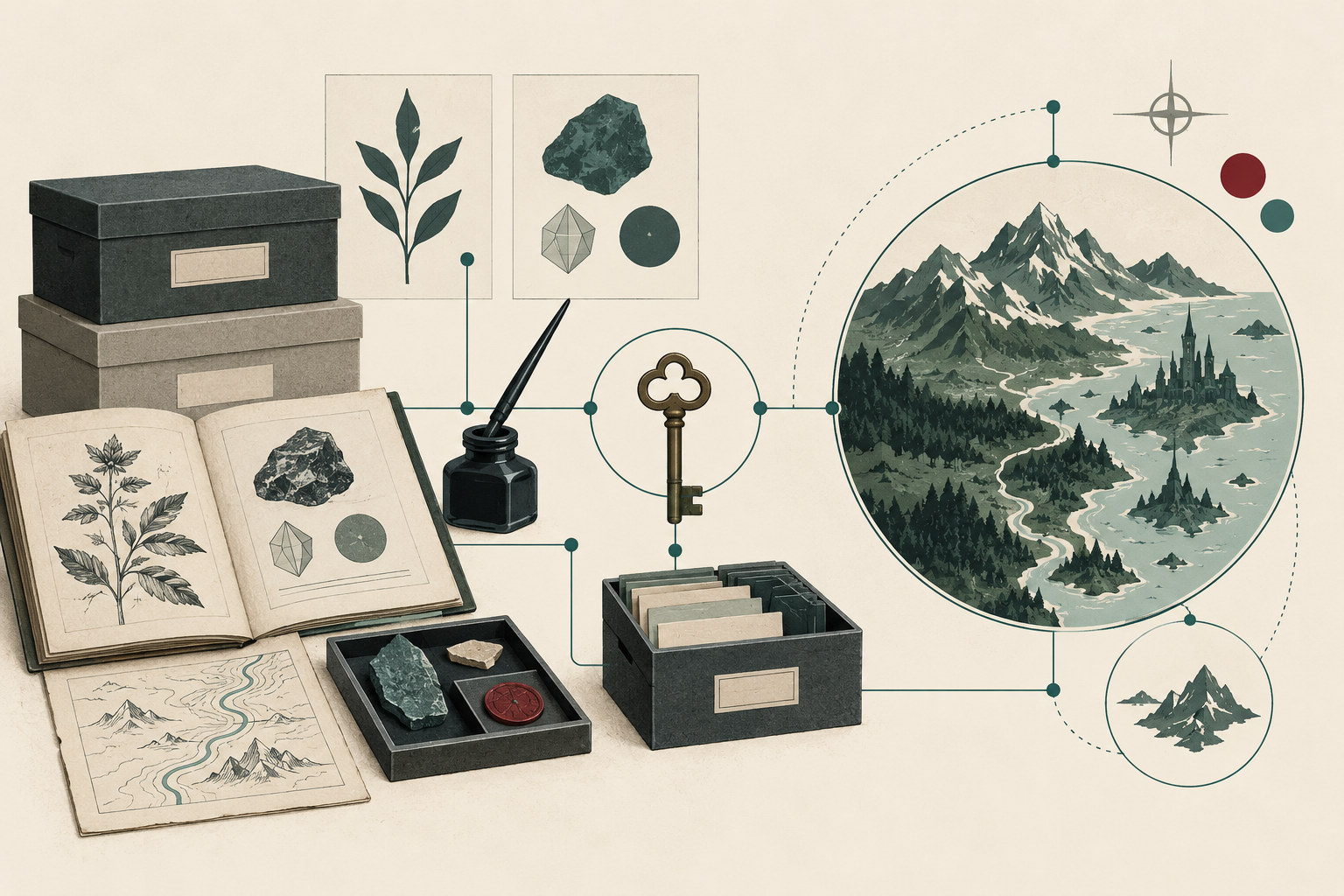
A convincing historical-fantasy world does not need an encyclopedia before it needs a story. It needs a system of pressure: what people use, who can reach it, who has authority over it, what it costs, and what changes when one impossible rule enters the system.
That method keeps research attached to character choices. It also gives a writer a way to distinguish the historical record from plausible interpretation and deliberate invention.
Begin with an equilibrium under pressure
Start by describing the ordinary arrangement that the story will disturb. “Renaissance Italy” is a setting label, not an equilibrium. A usable equilibrium sounds more like this:
A workshop depends on commissioned copying and record work. Access to sensitive papers is controlled. A skilled woman can contribute to the work, but her position becomes vulnerable when a disputed record attracts scrutiny.
That statement creates questions worth researching. What materials does the work require? Where are documents stored? Who can authorize access? What happens when a patron, household, workshop, or court contests a record?
The questions are more productive than collecting period facts at random because every answer can alter an action in the story.
Map the material layer
List the physical things that make the story possible. For a record-centred world, that may include paper, ink, pens, bindings, storage furniture, seals, keys, lamps, tables, drying materials, and transport containers.
Then ask four questions about each object:
- Who makes or supplies it?
- Who can afford or control it?
- What traces does use leave behind?
- How can it fail, decay, or be altered?
Material history can generate plot without becoming a lecture. Iron-gall ink, for example, was widely used in Western manuscripts, and its components can contribute to corrosion of paper and parchment over time. That fact is useful not because every scene needs a chemistry lesson, but because writing has a physical afterlife: it can fade, bleed, damage its support, or require conservation. The Library of Congress provides both an overview of iron-gall ink and research on iron-gall ink corrosion.
Paper can also carry evidence of manufacture. Historic watermarks may help researchers identify a paper maker, region, or approximate period, although interpretation requires comparison and care. The Library of Congress explains how transmitted-light imaging reveals historic watermarks.
The practical lesson is simple: give every important object a supply chain, a custodian, and a failure mode.
Map access, not just geography
A map tells you where a repository is. An access map tells you who can enter, read, borrow, copy, certify, or alter what it contains.
For each important place, record:
| Place | Custodian | Admitted people | Restricted action | Price of refusal |
|---|---|---|---|---|
| Workshop | master or household | workers, clients, suppliers | unsupervised use of sensitive records | loss of work or trust |
| Private collection | owner or delegate | invited scholars and agents | copying or removal | exclusion or accusation |
| Institutional archive | appointed official | authorized petitioners | access to protected registers | delay, denial, or legal risk |
This is a model for fiction, not a universal claim about every early modern archive. Its value is that it turns “there are old documents” into a network of permissions and consequences.
Historical institutions were neither uniform nor static. Even literacy did not automatically confer access or authority. Treat workshop practice, household power, civic administration, universities, and courts as separate systems until research shows how they connect in the time and place you are using.
Add one speculative rule
The strongest fantasy mechanism is often narrower than the writer’s first idea. State one impossible rule in operational language, then refuse to solve every difficulty by expanding it.
In the Two-Dated Archive, paired surviving sheets can carry fresh marginal writing across a fixed interval of 103 years. The exchange does not transmit drawings, voices, people, or objects. Margin space is finite, and erasure damages nearby ordinary writing in both dates.
Those restrictions are invented. Their purpose is not to imitate a historical belief. They create decisions about custody, evidence, trust, and the value of limited space.
Test the rule against the material and access layers:
- Does it require an object that can be lost, damaged, or controlled?
- Can someone monopolize access without possessing supernatural power?
- Does using it leave evidence or consume a scarce resource?
- Can an ordinary institutional decision make the rule dangerous?
- Does the rule complicate a choice rather than complete it for the character?
If the answer to all five is no, the mechanism may be decoration rather than a world system.
Attach cost to use, not merely possession
A cost matters when it changes what a character is willing or able to do. “Magic is tiring” is abstract until tiredness causes a missed appointment, a transcription error, or dependence on someone untrustworthy.
The archive’s most important cost is not spectacle. It is damage to ordinary writing. Erasing a transmitted line risks nearby records in both dates. A character choosing whether to correct, conceal, or leave a message is therefore also choosing what mundane evidence may be harmed.
That cost binds the invented rule to the record-centred world. It can be understood by a reader, tested in scenes, and used without continually adding powers.
Put three people in different positions
Worldbuilding becomes visible when characters occupy different relationships to the same system. Test at least three positions:
- someone who has skill but insecure authority;
- someone who controls access but lacks complete knowledge;
- someone excluded from the institution who still bears the consequences.
Livia Serrani begins in the first position. She can read, copy, compare, and preserve records, yet skill alone does not secure her place when a dangerous anomaly appears. Another character might hold keys or commissions. A third might need the truth recorded in a document they cannot inspect.
These positions generate conflict before the fantasy mechanism does. The mechanism intensifies what already matters.
Keep a claim-level evidence ledger
Do not let “researched” become a blanket label. Track individual claims in three classes:
| Class | Meaning | Example from this project |
|---|---|---|
| Fact | supported by a cited source | iron-gall ink can contribute to substrate damage |
| Inference | a plausible interpretation that needs checking | a disputed record could put pressure on a workshop worker |
| Invention | a declared fictional element | paired sheets exchange marginal writing across 103 years |
Primary-source analysis offers a useful discipline here: observe first, distinguish observation from inference, then seek more evidence to test the interpretation. The Library of Congress describes this movement from observation to reflection and further investigation, while the U.S. National Archives teaches a sequence of meeting a document, observing it, making sense of it, and using it as evidence in its document-analysis worksheets.
A compact worldbuilding record
Use this schema for each story-relevant system:
- Threatened equilibrium: What ordinary arrangement is about to fail?
- Material: What physical objects make it work?
- Custody: Who controls those objects?
- Access: Who may use, read, move, or alter them?
- Authority: Whose interpretation has force?
- Cost: What is spent, risked, or damaged?
- Speculative rule: What single impossible condition changes the system?
- Character positions: Who benefits, who is exposed, and who is excluded?
- Evidence status: Which claims are fact, inference, or invention?
- Research gate: What must be verified before drafting a scene?
Research only as far as the next decision
The aim is not to finish learning about an era. It is to know which facts a scene depends on. Record unresolved questions as gates instead of filling them with confident invention.
For this pilot, broad historical anchors—such as the University of Padua’s long institutional history and Galileo’s documented Padua years—can establish a research direction. They do not validate the exact procedure of a fictional workshop, archive request, property dispute, or university encounter. Those details need narrower sources before they appear as scene-level fact. The university’s own accounts provide starting points for the history of the University of Padua and Galileo’s years in Padua.
That restraint makes the world more flexible, not less. It prevents an attractive assumption from becoming a load-bearing error.
Continue through the connected records
See the World Building library for the broader catalogue, then explore the Two-Dated Archive as a worked setting, Livia Serrani as a character shaped by its access rules, and The Register That Writes Back as the plot pressure those rules create. The Faded Fables process explains how evidence labels and canon gates are handled across the project.
The useful test for any historical-fantasy world is not “How much do I know?” It is “Can I show what this system lets each character do—and what it makes them risk?”