
Plot dossier
The Register That Writes Back: Plot Record
A public plot record: pressure, causality, reversals, and the consequences that change a story.
The public dossier
An apprentice restoring a Florentine property register discovers that its margins answer a writer 103 years in the future. The page can reveal where to investigate—but it cannot make anyone believe her.
A premise becomes a plot when each discovery changes the next choice. In The Register That Writes Back, the impossible folio is not a stream of convenient clues. It is a scarce, damageable object that makes Livia’s ordinary decisions more costly.
The resulting plot is an investigation about evidence, but its central pressure is personal: will Livia preserve a contradiction that may restore erased claims when visible uncertainty threatens the permanent work her household needs?
At a glance
| Plot mode | Causal historical-fantasy investigation |
| Protagonist | Livia Serrani, fictional apprentice copyist |
| Inciting event | A century-old warning appears beside a correction she has not begun |
| External pressure | A damaged property register must be made ready for review |
| Internal pressure | Livia equates a clean page with safety and professional worth |
| Opposition | Controlled access, patronage, damaged evidence, partial disclosure, and Livia’s own need for certainty |
| Spoiler boundary | This page withholds the late crisis, decisive action, and aftermath |
Premise versus plot
The premise is simple: two writers communicate through paired folios 103 years apart.
The plot begins when that communication predicts Livia’s next act and interferes with a property record someone benefits from making clean. The distinction matters. A series of strange messages could produce atmosphere; a plot requires the first message to alter what Livia does, which alters what the opposition can do, which produces a more difficult decision.
The central story question
Will Livia preserve and expose a contradiction that could restore erased claims when doing so may cost the workshop position that keeps her household solvent?
The wording joins three levels of conflict:
- Material: what is actually on the register and its supporting records?
- Institutional: who controls the copy, review, and consequences?
- Personal: what does Livia believe a good copyist is supposed to remove?
The question cannot be answered by proving the folio is magical. Even perfect proof of the magic would not decide who has standing, whether a claim is true, or which ordinary records were altered.
The inciting event
A sentence appears in Livia’s blank margin in ink that looks a century old. It warns her not to complete a correction she has not yet begun.
The event works because it is both impossible and specific. It attacks the task already in her hand. It also demands a test. Livia can compare ink, fiber, pressure, and timing before she has to decide what the sentence means.
The opposing pressures
Livelihood
Bellori can reward neat work and withdraw access. Permanent employment is not a token prize; it is the practical security that makes compliance attractive.
Patronage
The person funding the work can define urgency, restrict comparison, and offer protection without issuing an obvious threat.
Damaged evidence
The register does not contain a pristine hidden truth. It contains omissions, repairs, competing hands, and gaps. Any conclusion has to be built across multiple imperfect records.
The future writer
The annotator in 1610 supplies information but not complete trust. Their motives, access, and limits are part of the mystery, not a channel for exposition.
Livia’s misbelief
External control succeeds because Livia already wants the same visible outcome: a page with no remaining contradiction. Her professional discipline can become the opposition’s tool.
A spoiler-safe because/therefore chain
- Because the warning predicts a correction Livia has not made, she devises a controlled test.
- Therefore the folio returns a detail she can verify without accepting the future writer’s interpretation.
- Because she hides the successful test, Bellori continues to treat her as compliant.
- Therefore she receives access to more sensitive pages.
- Because those pages omit names that survive in Caterina’s receipts, Livia discovers a pattern rather than a single error.
- Therefore the problem expands from an uncanny page to a coordinated documentary alteration.
- Because the 1610 writer reveals that a later dispute depends on Livia’s register, every correction now has consequences in two dates.
The later chain is withheld. Public plot pages should show enough causality to be useful without converting the dossier into a synopsis of the ending.
The midpoint expansion
At the midpoint, Livia learns that the future writer is not observing a closed past. A dispute in 1610 depends on the page she is restoring in 1507.
This changes the scale of the question. The issue is no longer whether a message can cross time; it is whether an apparently tidy record can continue distributing advantage for more than a century. The speculative rule and the property conflict become the same plot rather than parallel curiosities.
The scene engine
Each major scene should contain five practical elements:
- Livia enters with an observable goal.
- Access, a person, or the condition of a record resists her.
- New evidence changes what the scene is about.
- Livia makes a choice that produces a consequence.
- The consequence determines the next necessary scene.
That pattern resembles scene frameworks built around inciting incident, turning point, crisis, climax, and resolution, but the labels matter less than the value shift. A scene about inspecting paper is dramatic only if the inspection changes trust, access, risk, or the next decision. Story Grid: scenes · Story Grid: cause and effect
Why ordinary evidence matters more than the miracle
The paired folio can expose a discrepancy or direct Livia toward a missing name. It cannot testify, authenticate itself to a civic body, or grant Livia authority. Receipts, copies, custody, witnesses, and the material sequence of an alteration remain necessary.
This rule prevents the plot from collapsing into “the magic says who is right.” It also keeps Caterina and other people outside the workshop from becoming background figures. Their ordinary records can carry facts the official copy does not.
Pacing and available space
The investigation alternates between expansion and narrowing. Early messages open new possibilities. Each exchange then consumes visible margin, while access to pages, instruments, and people becomes tighter.
The physical page gives the pacing a clock the reader can understand. There are only so many lines left. The final third can narrow locations and options without inventing a sudden deadline, because every earlier exchange has made the remaining space measurable.
Character arc and plot alignment
The plot rewards Livia’s misbelief before it challenges it. Clean restoration wins praise. Missing names reveal the harm inside that definition of success. Concealing the first test gives her private agency, but the widening consequences eventually make private accuracy insufficient.
This alignment is the point of the plot record: events do not merely happen around the protagonist. Each turn changes the meaning of her skill and pushes the character question toward a choice only she can make.
Spoiler boundary
This public record reveals the paired-folio rule, the damaged property record, the first test, Caterina’s counter-records, and the two-date scope. It withholds the future writer’s identity, the precise instrument involved, the late crisis, the decisive action, and the aftermath.
Fact and invention note
The plot and characters are invented. The material behavior of real ink and paper, Florence’s 1507 political interval, Padua’s 1610 scholarly context, and the coexistence of print and manuscript practice are research anchors. The exact property-review procedure remains unresolved and must not be presented as documented history.
Follow this plot
- Meet Livia Serrani, whose misbelief makes the plot personal.
- Enter The Two-Dated Archive for the rule, cost, and institutions.
- Open The Chronicles of Renaissance Scribes for the combined story dossier.
- Visit Plot Building for plot outlines, causality, scenes, and structure guides.
Connected records
These cards use the exact relationship IDs recorded for this dossier.
Characters
The people whose choices drive this plot.
Connected record
Livia Serrani: Character Record
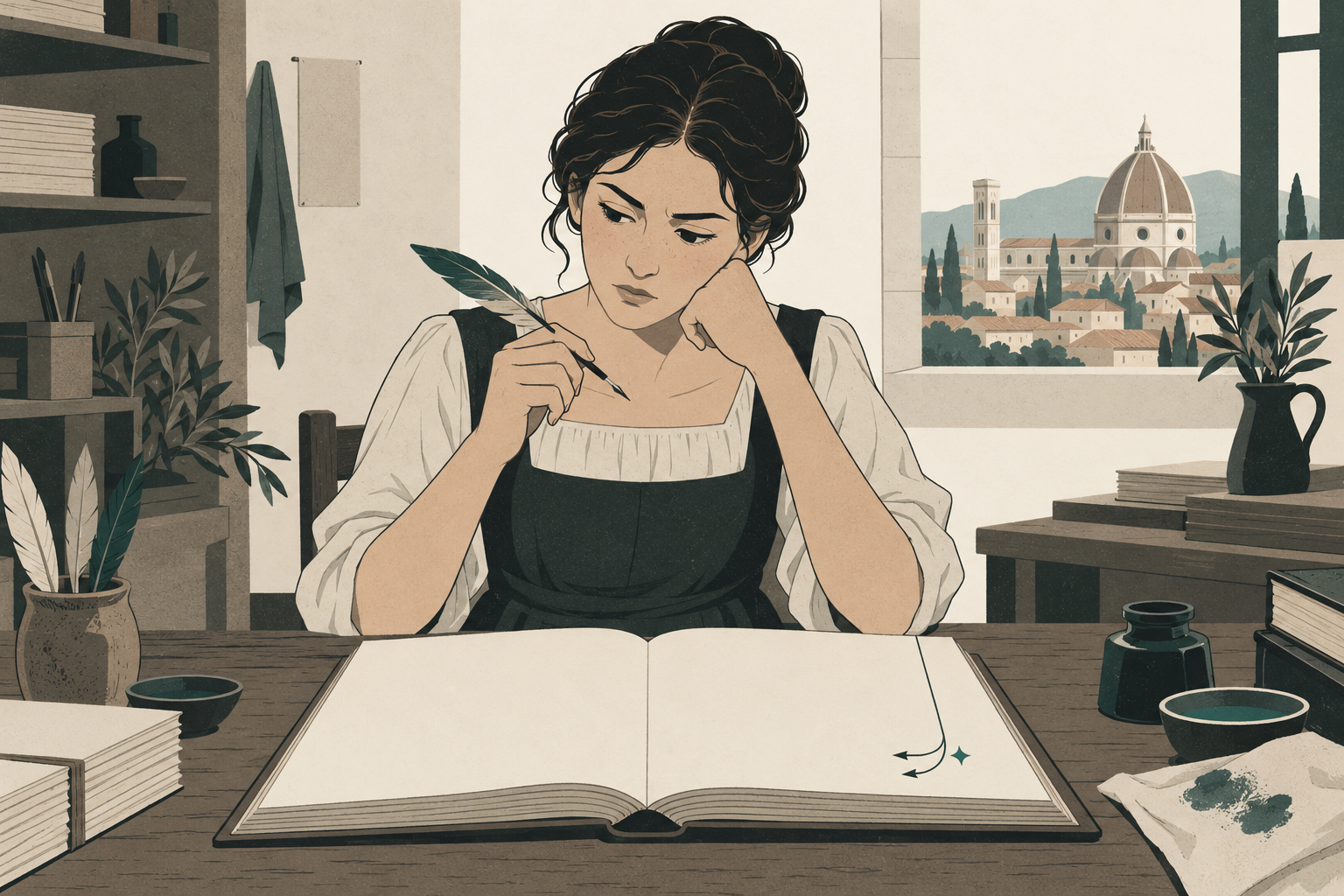
Meet Livia Serrani, a fictional Florentine copyist whose desire for a secure, flawless record collides with evidence the archive tried to erase.
Open recordWorlds
The systems that constrain this plot.

Connected record
The Two-Dated Archive: World Record
Explore a historical-fantasy world linking Florence in 1507 to Padua in 1610 through scarce marginal ink, physical records, and costly erasure.
Open recordStories
The stories built from this causal route.
Connected record
The Chronicles of Renaissance Scribes
Explore the character, world, plot, research, and honest development status behind The Chronicles of Renaissance Scribes.
Open recordField notes
Craft and research notes connected to this record.

Connected record
How to Build a Historical-Fantasy World from Records, Materials, and Access
Build a historical-fantasy world by mapping materials, access, authority, cost, and one speculative rule, with a practical worked example.
Open record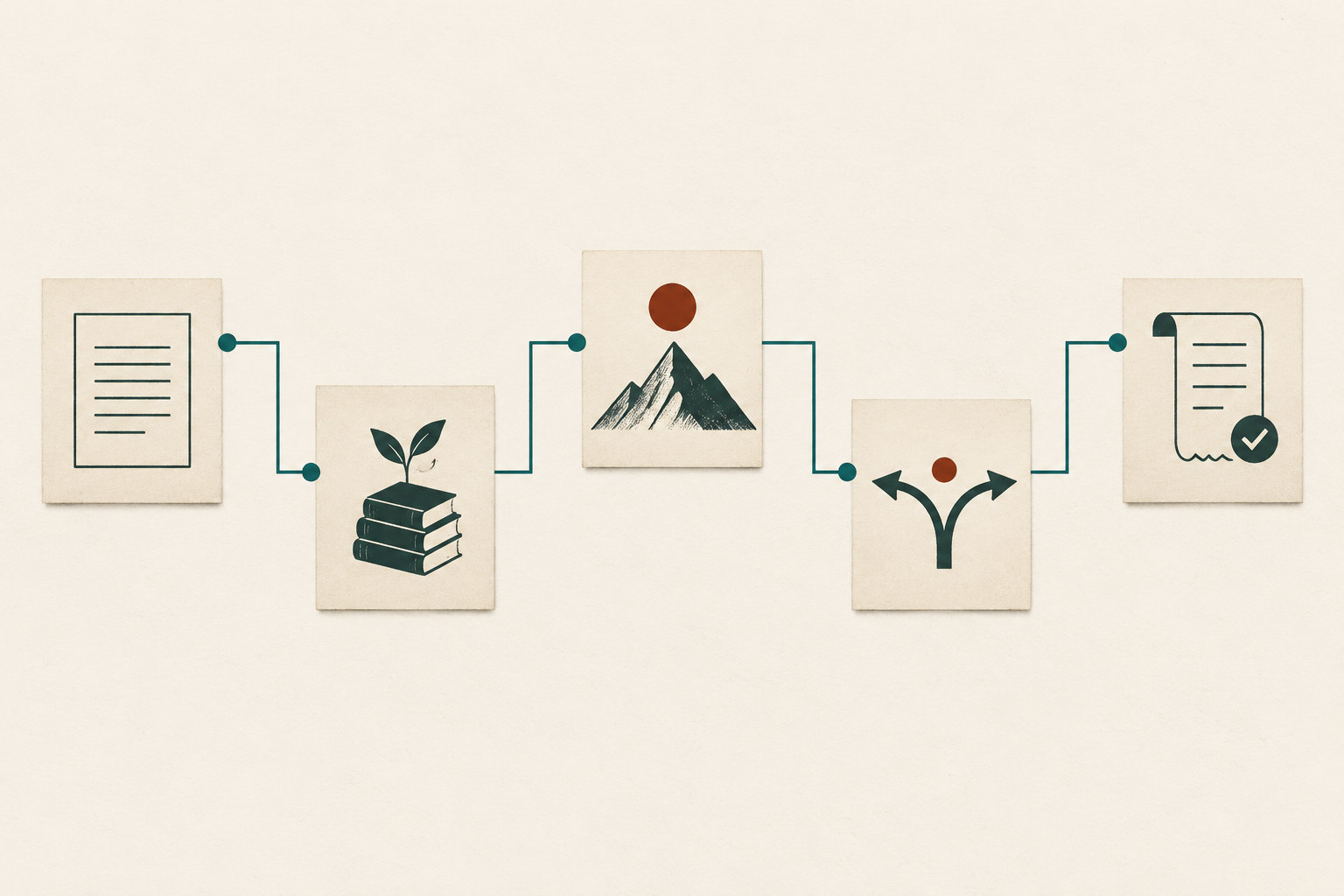
Connected record
A Plot Structure Example Built with Because/Therefore Causality
Use because/therefore causality to turn a premise into a plot where every choice closes an option and creates the next problem.
Open record
Connected record
What Belongs in a Character Sheet for a Novel?
Build a novel character sheet that tracks goals, conflict, voice, relationships, knowledge, continuity, and change without collecting trivia.
Open record
Connected record
How to Separate Historical Fact, Inference, and Invention
Use a claim-level fact, inference, and invention ledger to research historical fantasy honestly without surrendering imaginative freedom.
Open record
Connected record
Magic with a Cost: Designing Rules That Create Story Choices
Design a fantasy magic system whose channel, limits, access, and cost create difficult character choices instead of convenient solutions.
Open record