
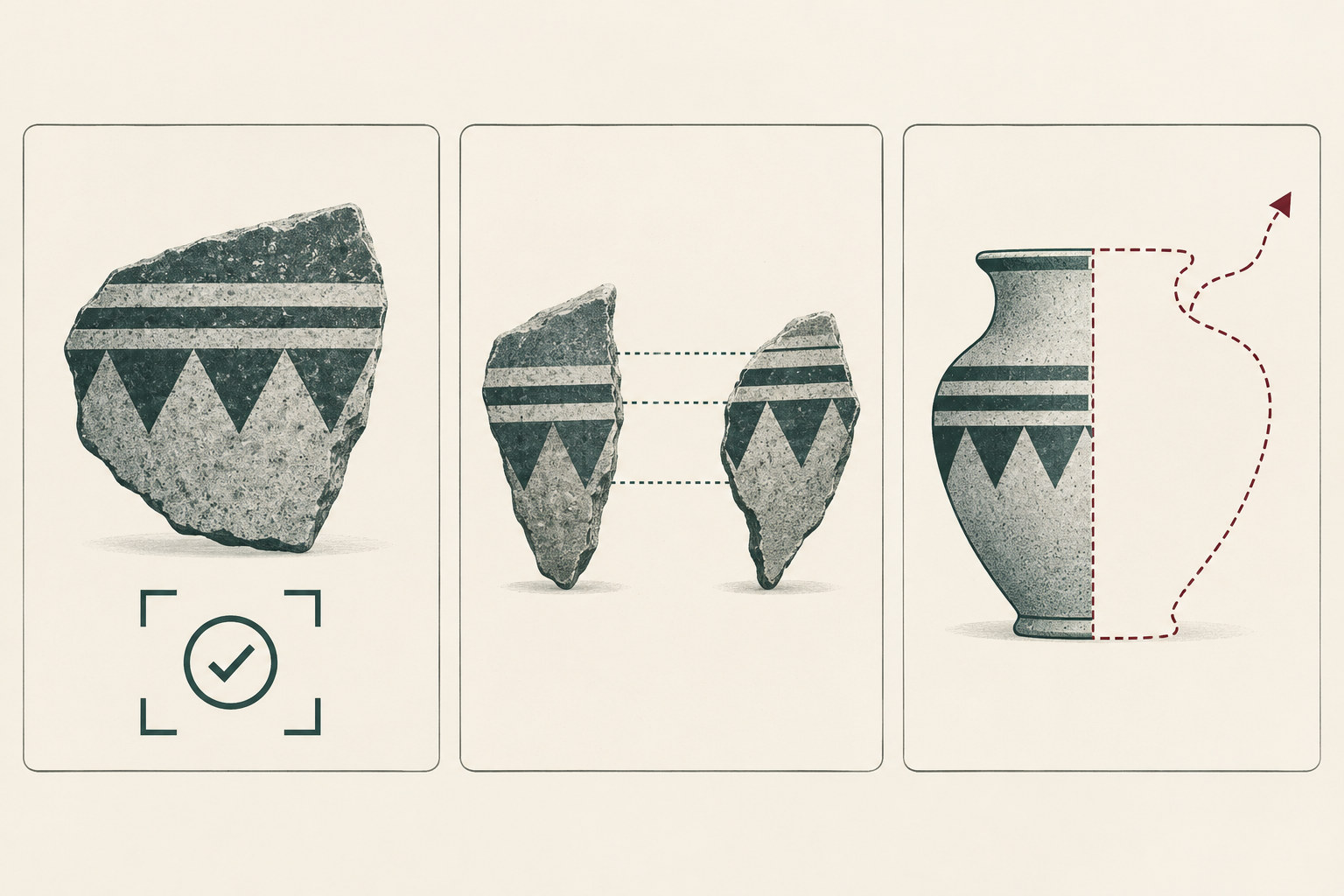
Historical fantasy becomes more trustworthy when the writer can answer a simple question at claim level: Do I know this from evidence, infer it from evidence, or invent it for the story?
The three classes can coexist in one paragraph or scene. The goal is not to eliminate inference or invention. It is to stop them from quietly acquiring the authority of documented fact.
Define the three evidence classes
Fact
A fact is a claim supported by a source appropriate to that claim. Record the source, the relevant passage or object, its date, its scope, and any limitations.
Examples for the Faded Fables pilot include:
- Galileo studied and taught at Padua during documented years, as described by the University of Padua and Museo Galileo.
- iron-gall ink was widely used and can contribute to damage in paper or parchment; the Library of Congress provides an historical overview and conservation research.
- early printed books could coexist with manuscript annotation and hand-drawn material; the Folger Shakespeare Library surveys writing technologies in the age of print and a 1482 Euclid with hand-coloured diagrams.
These facts establish possibilities and constraints. They do not prove that a fictional person handled a particular book or followed a particular procedure.
Inference
An inference is a reasoned conclusion drawn from evidence but not directly established by it. Inference is essential; historians and writers both interpret incomplete records. It should carry a confidence level and an explanation of the reasoning.
Examples:
- A worker whose livelihood depends on trust may face pressure if anomalous writing appears in material under their care.
- Property and documentary disputes could expose differences between practical skill and formal authority.
- A person accustomed to comparing hands, paper, and textual variants might test an unusual message materially before accepting a supernatural explanation.
Those propositions are plausible. They are not yet scene-level facts about a specific workshop, legal venue, or woman’s occupational status. Narrower research is required before the story assigns them a precise procedure.
Invention
An invention is something the project deliberately creates. It may be compatible with a historical setting, but it is not presented as discovered history.
The Two-Dated Archive, its paired sheets, its 103-year interval, Livia Serrani, and the cross-century correspondence are inventions. Declaring that boundary gives the fantasy mechanism room to be imaginative without recruiting real institutions as false evidence.
Analyse a source before extracting a claim
The U.S. National Archives teaches document analysis in four broad movements: meet the document, observe its parts, make sense of it, and use it as historical evidence. Its document-analysis worksheets also remind researchers to identify the document type and intended audience before drawing conclusions.
For every source, capture:
- creator and date;
- document or object type;
- intended audience and purpose;
- place and institutional context;
- what can be observed directly;
- what is being inferred;
- whose perspective is absent;
- contradictions or uncertainty;
- which story claim the source can actually support.
Primary sources are not neutral windows. The National Archives’ guidance on using history in the raw stresses point of view, bias, contradiction, and the limits of reliability. The Library of Congress likewise recommends examining sourcing and context, not treating a document’s survival as proof of a complete picture.
Keep a claim-level ledger
A bibliography tells you what you read. A claim ledger tells you what the writing depends on.
| Claim ID | Proposed claim | Class | Source or rationale | Confidence | Permitted use | Gate |
|---|---|---|---|---|---|---|
| M-01 | iron-gall ink can damage its support | fact | Library of Congress conservation sources | high within stated scope | public context and material stakes | none |
| P-01 | a record dispute threatens Livia’s workshop standing | inference | livelihood/trust logic; exact procedure unverified | medium | premise-level summary | verify local practice before a legal scene |
| F-01 | fresh marginal ink crosses 103 years | invention | locked world rule | canon-approved | public world and story pages | do not expand power set |
The permitted use field prevents a broad source from doing narrow work. A museum overview may support material context but not a line of dialogue, price, job title, route, or legal process.
Treat absence of evidence carefully
An absence can mean many things: the practice was rare, records did not survive, the archive excludes certain voices, terminology changed, or the researcher has not found the right collection.
Do not turn “I found no evidence against it” into “therefore it happened.” Record the absence as an open question. If the story still needs the element, choose among three honest routes:
- research a narrower source base;
- present the element as a restrained inference;
- redesign it as explicit invention without attaching it to a real person or institution.
This matters especially when writing people underrepresented in formal archives. Silence in an institutional record is not proof of inactivity, but neither does it license any specific claim.
Use real people and institutions at the right resolution
A documented date can anchor a fictional chronology. It does not authorize a private meeting, opinion, or intervention by a historical person.
For example, the University of Padua and Museo Galileo can support the broad chronology of Galileo’s Padua period. A scene in which Galileo evaluates the Two-Dated Archive would be invented, and it would also risk letting a famous name validate the fantasy mechanism. The cleaner choice for this project is to keep historical figures at an appropriate distance unless a scene has both documentary support and a clear artistic reason.
Likewise, scholarship on marital property in Renaissance Florence can identify relevant legal questions, but it cannot automatically be transferred to every city, decade, household, or dispute. The chapter on property of spouses in Renaissance Florence is a research lead with a defined jurisdiction and subject, not a universal rule for early modern Italy.
Label images and visual reconstructions
Images need the same boundary as prose. For each visual, record:
- documentary: a historical object or source image, with institution, identifier, rights, and date;
- interpretive: a diagram or reconstruction derived from evidence, with the uncertain parts named;
- concept art: an invented visualization of the story world;
- composite: a design combining elements that never appeared together historically.
Do not use concept art as proof of clothing, architecture, handwriting, or object design. Alt text should describe what the image shows, while the caption or credit explains status and provenance.
Publish useful notes without exposing the production ledger
A public research note can say:
The material context draws on conservation and collection sources about iron-gall ink, paper, manuscripts, and early print. The paired folios and their cross-time exchange are fictional.
It does not need to publish private clue schedules, unresolved plot alternatives, or scene-level research questions. Public transparency and spoiler control are compatible when evidence labels are designed into the content model.
A reusable research workflow
- Write the claim the scene requires.
- Classify it provisionally as fact, inference, or invention.
- Find a source appropriate to the claim’s time, place, institution, and specificity.
- Record observation separately from interpretation.
- Note bias, missing perspectives, and contradictory evidence.
- Set confidence and permitted use.
- Create a research gate if the scene needs greater precision.
- Reclassify the claim when new evidence changes it.
- Label public notes and visuals consistently.
The Library of Congress’s guidance on distinguishing observation from inference is especially useful at step four: an interpretation becomes a hypothesis to test, not a fact to repeat.
See the method in the story graph
Read the Faded Fables process for the site-wide evidence policy, the Two-Dated Archive for a fact/inference/invention boundary applied to a world, and The Chronicles of Renaissance Scribes for the public story context. The About page explains the broader editorial purpose of the project.
Research does not reduce the writer’s imaginative freedom. It tells the writer where imagination begins—and makes that beginning a conscious artistic choice.