
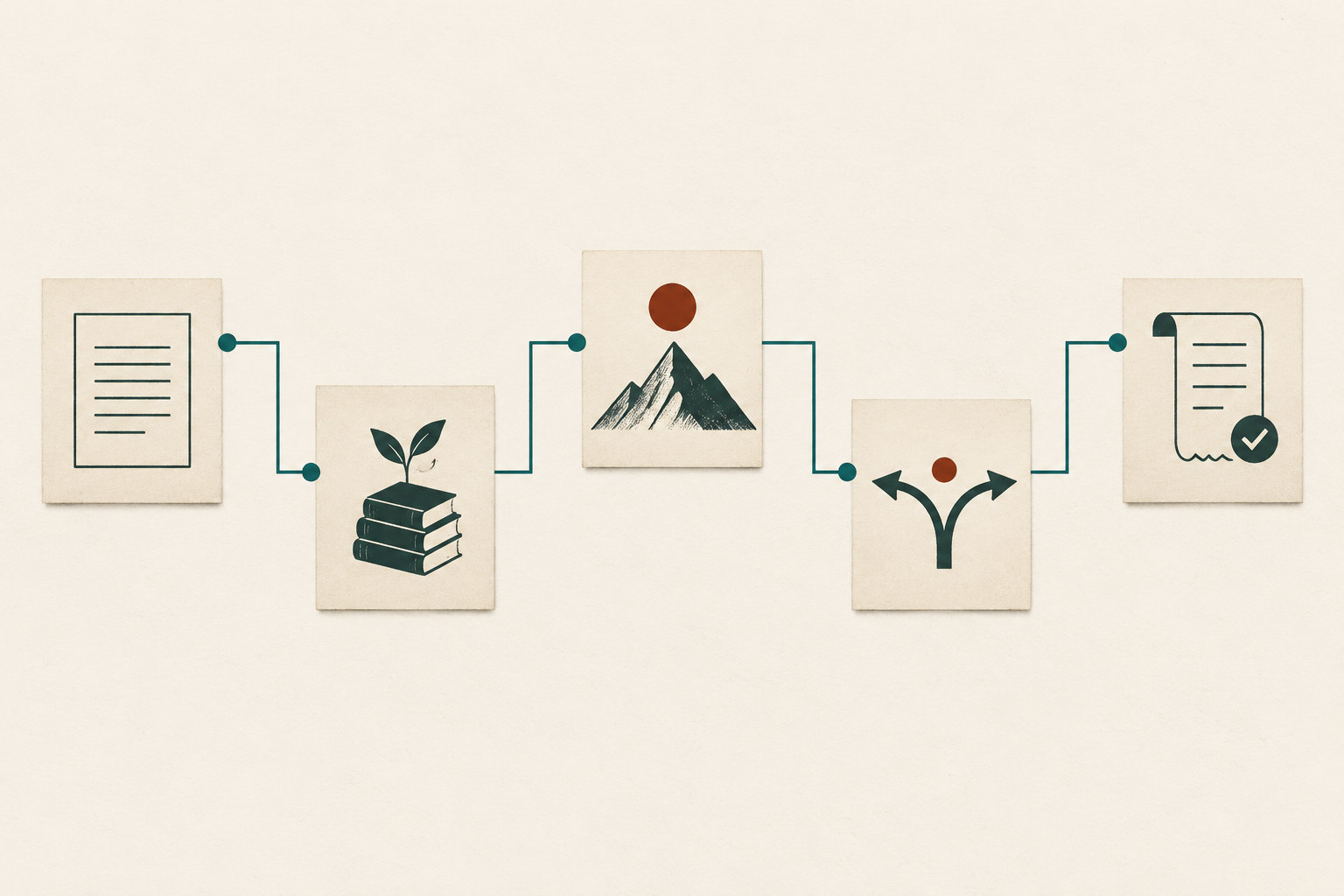
A premise tells us what is unusual. A plot tells us why the next event can no longer be avoided.
The quickest way to test that difference is to connect major events with because and therefore. If the only honest connector is “and then,” the sequence may contain activity without causality. A causal plot makes each consequential choice remove an easy option and create the next problem.
This is one structural tool, not a universal law. It works especially well when a story depends on investigation, escalating responsibility, and choices whose consequences cannot be reset.
Premise is possibility; plot is consequence
Consider this premise:
A sixteenth-century copyist discovers that fresh writing in a manuscript margin can be answered 103 years later.
It contains a character, an impossible event, and a question. It does not yet contain a plot. Almost anything could happen next.
The character, archive, and 103-year exchange in this example are fictional. The sequence below demonstrates structure; it does not present the mechanism as a historical claim or the protected novel outline as public fact.
Now add a choice:
Livia receives a warning in a margin and chooses to test whether the response is real.
That choice changes the situation. She has created evidence, implicated herself in the exchange, and learned enough that simple dismissal is no longer available.
The Story Grid describes scenes as units in which a character pursues an objective under pressure and the value at stake changes. Its account of scene structure and discussion of cause and effect in story offer useful vocabulary for this approach. The underlying craft question is broader than any one system: what did the character do that made the next difficulty possible?
Build a five-link causal chain
Write the public, spoiler-safe spine of the story as five links. Each link should contain an event, a decision, and a consequence.
1. Disruption
A fresh warning appears where no fresh ink should exist.
This is the event that makes the ordinary explanation insufficient. The character still needs a choice. She can report it, hide it, destroy it, ignore it, or test it.
2. Controlled response
Because Livia fears both fraud and accusation, she makes a restrained test instead of announcing a miracle. Therefore she receives evidence that the exchange is responsive rather than accidental.
The test closes the option of innocent ignorance. It also gives her a reason to protect the folio.
3. Sensitive access
Because the warning concerns a record outside her ordinary reach, she needs access to more sensitive material. Therefore she must depend on permissions, relationships, or risks she did not need before.
Notice that the fantasy mechanism does not open a door. The social system does. This keeps the plot attached to character and world rather than turning magic into a universal key.
4. Ordinary evidence
Because extraordinary claims are dangerous and easy to dismiss, Livia looks for mundane traces: receipts, hands, bindings, dates, custody, and contradictions. Therefore the investigation begins to affect real obligations and reputations.
The plot grows by connecting the impossible message to evidence that other people understand. That change broadens the stakes without requiring a larger magical power.
5. Cross-century consequence
Because messages alter what someone in the other date knows and does, each exchange changes the conditions of the next one. Therefore communication becomes intervention, and intervention demands a choice about responsibility.
For this public example, the chain stops there. The final crisis, protected clues, and ending of The Register That Writes Back remain private production material.
Make “therefore” close an option
A weak consequence adds information. A strong consequence changes the menu of available actions.
Compare these versions:
- She tests the margin; therefore she learns it works.
- She tests the margin; therefore she can no longer deny that her handwriting has entered a dangerous record.
The second consequence contains a loss. Even if no one else has seen the writing, Livia’s relationship to the object has changed.
Useful closures include:
- loss of anonymity;
- loss of institutional access;
- loss of time;
- damage to evidence;
- dependence on another person;
- a promise that cannot be kept without harm;
- knowledge that makes neutrality impossible.
Do not close every option. Plot requires pressure, not puppetry. Leave the protagonist at least two meaningful choices, each with a different cost.
Use a scene card that records change
For each scene, complete this compact card:
| Field | Question |
|---|---|
| Objective | What does the viewpoint character want before the scene ends? |
| Obstacle | Who or what resists that objective? |
| Tactic | What does the character choose to do? |
| Turn | What new fact, refusal, cost, or action changes the scene? |
| Value shift | What is better or worse by the end? |
| Because | Which earlier choice made this scene necessary? |
| Therefore | Which option closes, and what new problem begins? |
| Knowledge boundary | What does this character know now—and what remains unavailable? |
The knowledge field is essential in a mystery or cross-time narrative. A writer who tracks only what the audience knows can accidentally let a character act on information they have not received.
Change the scope at the midpoint
A midpoint does not need to be a twist inserted at page 150. It needs to alter the protagonist’s understanding of the problem or the scale of responsibility.
In a causal chain, ask:
- Which earlier assumption stops working?
- What evidence changes the central question?
- Does the protagonist move from reacting to choosing a strategy?
- What new responsibility follows from that knowledge?
For the archive story, the public version of the scope change is enough: the exchange is not merely an anomalous message to be decoded. Writing back can change what survives, who can act, and what evidence is damaged. The protected answer to how that responsibility resolves does not belong in a craft example.
Design a crisis from competing costs
A crisis is strongest when the protagonist cannot preserve every value. Instead of asking “Will she succeed?”, frame a choice:
Will she protect one record by risking another, or preserve the ordinary evidence by leaving a dangerous message unanswered?
That example uses the published rule of the Two-Dated Archive: margin space is limited, and erasure damages nearby ordinary writing in both dates. It does not disclose the novel’s actual final decision.
A useful crisis choice should be:
- caused by earlier actions;
- legible before it arrives;
- costly on both sides;
- specific to this character;
- impossible to solve by a newly introduced power.
Diagnose an “and then” draft
Print the beat list and write a connector between every pair. When “because” or “therefore” feels false, diagnose the gap:
- Missing decision: an event happened, but nobody chose a response.
- Missing cost: the choice did not change any later option.
- Missing evidence: the character acts on information the scene never supplied.
- Repeated function: two beats create the same kind of pressure.
- External rescue: coincidence or authority resolves a consequence the protagonist created.
- Unseeded rule: a new capability appears only because the plot needs it.
Repair the smallest missing link. Often the draft needs one refusal, discovery, obligation, or sacrifice—not another subplot.
A reusable spoiler-safe worksheet
The worked example above is a Renaissance Scribes premise; the plot record it belongs to is The Register That Writes Back. More craft notes are collected in Field Notes.
Complete one line for each major movement:
Because [character] chose to __ after learning _, therefore became impossible and ___ became necessary.
Then test the chain from the opposite direction:
If the earlier choice were removed, would the later event still occur in substantially the same way?
If yes, the events may be adjacent rather than causal.
Where this sits against the three act structure
Most plot guidance arrives already divided into three acts — setup, confrontation, resolution — or five, with the midpoint marking the turn. That scaffolding is useful for measuring a draft, and it is worth being precise about what it does and does not settle.
The three act structure answers a question about proportion: roughly a quarter of the story establishes the ordinary world and the want, the middle two quarters escalate under opposition, and the final quarter resolves the debt. The five act structure inserts the midpoint as its own stage, because the most common structural failure is not a weak ending but a middle that never changes shape.
Because/therefore causality answers a different question. Ask why does this happen next, and the three acts stop being a shape to fill and become a consequence to verify. A draft can hit all three act beats perfectly and still be an “and then” draft, because each scene may follow the last without any pressure forcing it.
Using both together
Treat the three act structure as the coarse frame and the causal chain as the fine one. Draft the chain first — five consequences, each closing an option opened by the last — then check the result against the frame. If the chain is sound, the acts tend to fall into place around it. If the chain has a soft joint, no amount of act discipline will hide it, because the problem is that nothing was forcing the story forward.
The practical warning sign: if you can describe your plot as a list of things that happen to a character, you have frames without causality. If you can describe it as a list of things the character chose, and each choice cost them an option, you have causality — and the frames will describe themselves.
For the character pressure that gives a causal chain something to push against, see how a character arc is built. For the consequences that make each link land, world building matters more than most drafts assume.
Follow the worked example without revealing its ending
Explore the broader Plot Building library, read the public dossier for The Register That Writes Back, and compare the chain with Livia Serrani’s character pressures and the Two-Dated Archive’s world rules. The Chronicles of Renaissance Scribes shows how the same records connect at story level.
The purpose of a plot structure is not to make every story look alike. It is to make consequences belong to the people who caused them.