
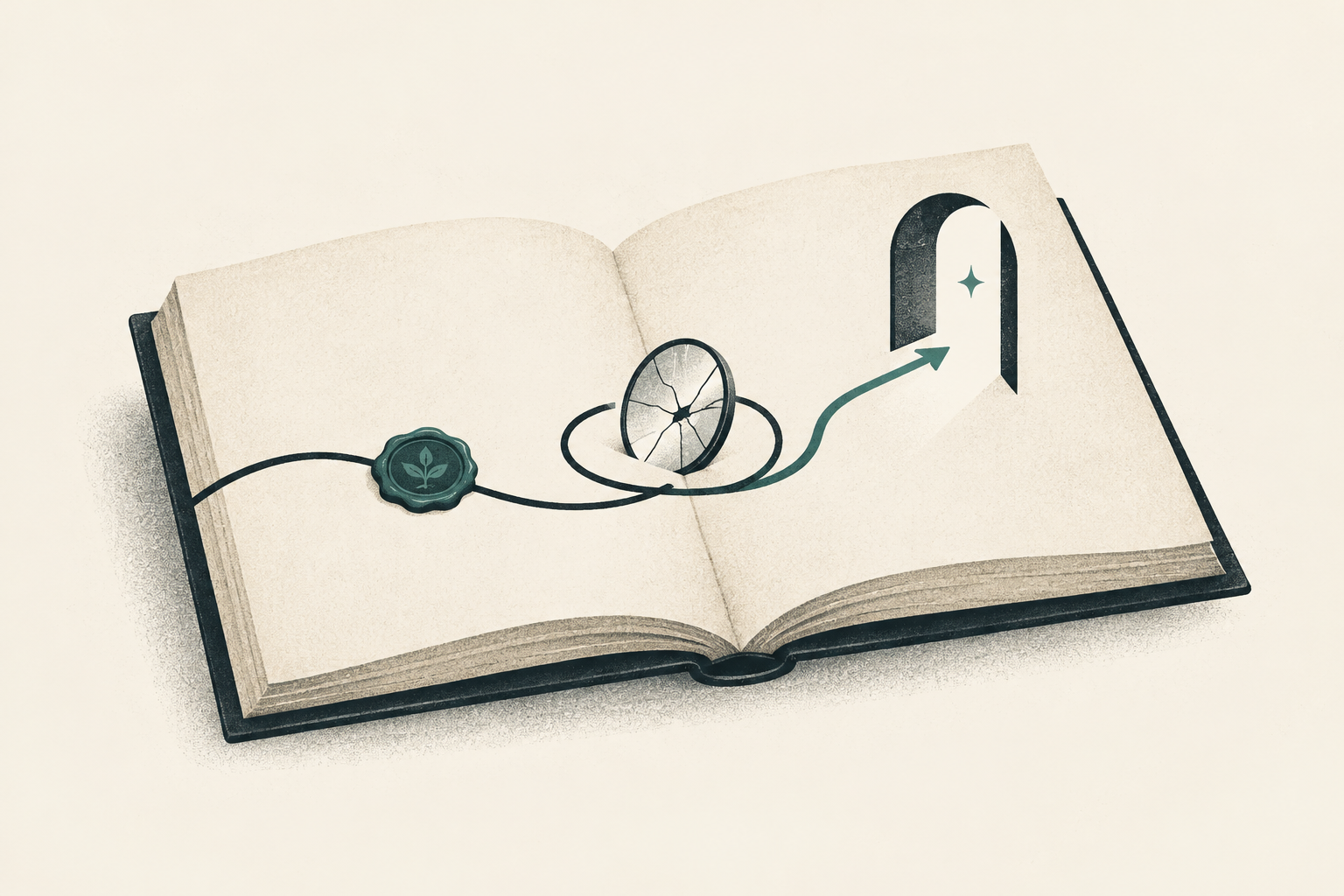
A character can cross a desert, expose a conspiracy, inherit a crown, and still finish the story exactly as they began. Events have happened to them, but no character arc has become visible.
Change appears when the plot tests the character’s usual way of getting what they want. Their strategy works—until it does not. Evidence accumulates. The price rises. At last, they must choose whether to protect the belief that has guided them or act from a different one.
That gives us a practical definition:
A character arc is the pattern created when pressure changes—or confirms—a character’s relationship to a governing belief, value, or strategy, and that relationship becomes visible through choice.
This guide uses desire, misbelief, pressure, and choice as a diagnostic model. It is not a law of fiction. Some protagonists transform. Some remain steadfast and change the people around them. Some recognize a better path and reject it. The useful question is not “Did I follow the correct arc formula?” It is “Can the reader trace why this person makes a different—or devastatingly familiar—choice at the end?”
What a character arc actually is
A character arc is not a personality transplant. A guarded person does not need to become sociable; an ambitious person does not need to renounce ambition. The meaningful change may be narrower: whom they trust, what they will sacrifice, how they define victory, or which evidence they permit themselves to see.
An arc is also not a résumé of events. “She loses her post, travels north, joins a rebellion, and defeats the regent” is a plot summary. To find the arc, ask how those events alter the rule by which she makes decisions.
Craft vocabulary differs. Reedsy’s current overview describes positive, flat, and negative arcs, while K. M. Weiland’s influential framework often uses want, need, lie, and truth. Those are useful lenses, not objective psychological categories. In this guide, misbelief means a limited working assumption that produces consequential behavior. It need not make the character foolish, immoral, traumatized, or factually wrong about everything.
Consider two guards who both refuse to abandon a city gate:
- One stays because she has learned that duty means protecting people, not obeying the governor. Her decision completes a positive change.
- One stays because she has always valued duty above survival and forces a frightened city to remember its own courage. Her decision expresses a steadfast or flat arc.
The action is similar. The arc lies in the relationship between the decision and the belief that produced it.
The four-part mechanism behind a character arc
The compact model is:
Desire creates pursuit. Misbelief shapes strategy. Pressure exposes the strategy’s cost. Choice reveals the governing belief.
Miss one part, and the arc often becomes difficult to read.
1. Desire gives the character somewhere to go
Desire is broader than a plot goal. A plot goal is concrete: recover the treaty before the coronation. The desire underneath might be security, recognition, belonging, freedom, justice, or proof that a parent’s faith was justified.
Both layers matter. A purely abstract desire cannot collide with the world. A purely mechanical goal gives the reader no reason this particular person must pursue it.
Try completing both sentences:
- The character is trying to: obtain, prevent, reach, protect, reveal, or escape something concrete.
- They believe success will finally mean: an emotional promise only they can define.
“Nera must finish the royal survey” supplies motion. “Finishing it will prove that precision can make her indispensable” supplies vulnerability.
2. Misbelief turns desire into a flawed strategy
A vague insecurity is difficult to dramatize. “Nera feels unworthy” may explain her mood, but it does not tell you what she does when a witness contradicts her map.
Phrase the misbelief as a conditional rule:
If I do X, then Y will be safe.
For Nera: If my work contains no uncertainty, powerful people will have no reason to discard me.
Now the belief produces behavior. She hides conflicting measurements. She distrusts testimony she cannot quantify. She treats questions as threats. Her admirable precision and damaging silence grow from the same root.
A useful misbelief usually contains some truth. Perhaps flawless work has protected Nera before. Perhaps an earlier admission of doubt cost her family their livelihood. If the belief has never worked, the reader will wonder why an intelligent character still relies on it.
3. Pressure supplies evidence and consequence
An arc needs more than a mentor announcing the theme. The plot should test the character’s strategy in several directions.
One effective sequence is:
- Confirmation: the old strategy succeeds, reinforcing the misbelief.
- Complication: the same strategy harms something the character values.
- Counter-evidence: another person or event demonstrates a viable alternative.
- Cost: accepting that alternative would require a genuine loss.
- Crisis: the character can no longer preserve the goal, the old belief, and everything they value at once.
Jane Friedman’s guest craft guidance on misbeliefs proposes a related progression: moments that confirm the belief, moments that make the character question it, and a moment that forces a choice. The sequence works because revision is not persuasion by slogan. It is an accumulating argument made from consequences.
4. Choice makes change legible
An epiphany is private. A choice enters the story.
The strongest arc choices bring two motivations into conflict. New York Book Editors’ interview with Nathan Bransford makes the same practical point: competing motivations reveal more than a single uncomplicated pursuit. The “right” option should not be a trapdoor marked virtue while the other is marked foolishness.
Test the climactic choice with four questions:
- Does the character want something on both sides?
- Does either choice cost them now, not only in theory?
- Will the decision change another person or the material situation?
- Could a reader understand why the character might still choose the old way?
Then add an aftermath. A changed character should behave differently when the story is no longer pausing to applaud the lesson. A short, concrete action—signing the uncertain map, telling the truth without being asked, leaving the medal unopened—often proves more than a final speech.
Three useful character arc shapes
Positive, flat, and negative are common craft labels, not the borders of all possible fiction. They are most useful when treated as different answers to the same pressure.
| Arc shape | Relationship to the governing belief | Climactic choice | Result |
|---|---|---|---|
| Positive change | Revises or releases the limiting belief | Acts from a more adequate belief despite the cost | Gains a fuller way of living, though the external goal may still be lost |
| Flat or steadfast | Begins with a durable value and learns how costly it is to uphold | Reaffirms the value under its severest test | Changes the surrounding people or world more than the self |
| Negative change | Encounters counter-evidence but protects or deepens the limiting belief | Chooses the old strategy when another path remains possible | Gains a hollow victory, causes loss, or becomes more trapped |
“Positive” does not mean cheerful. A character may accept a painful truth and lose the thing they first wanted. “Negative” does not mean the character becomes a theatrical villain. They may make a small compromise that prepares the next one.
A steadfast protagonist is not the same as an underdeveloped one. Reedsy’s flat-arc description emphasizes a protagonist who maintains a conviction under opposition and becomes a catalyst for change elsewhere. The test is still costly choice. If nothing can tempt, frighten, or compromise the character, steadfastness is only immunity.
How to write a negative character arc
A negative character arc is the one most writers mean when they say a character arc, and the one most often written wrong. The character meets evidence that their governing belief is wrong, understands it, and then chooses the belief anyway. The change is real — it runs the other way. They become more certain of the thing that is costing them everything.
What makes a negative arc work is not the refusal itself. It is that the refusal is costly and available. A reader stays with a character longer when they could have stopped.
Three requirements for a negative character arc
1. The counter-evidence must be undeniable. The character has to learn the truth, in their own terms, through something they cannot unsee. If they merely fail to notice the evidence, you have written a character who is not paying attention, not one who is choosing.
2. The old strategy must still be viable. The negative arc collapses when the character has no remaining reason to keep going. Leave one door open — a person who still loves them, a duty they still honour, an outcome they still believe is worth it.
3. The climax must be chosen, not forced. The decisive moment needs an alternative the reader can see was genuinely there. Remove it and the negative arc becomes a plot accident.
Negative arc example: the archivist who signs her own name
Suppose a state archivist has spent her career proving that records cannot be edited — that an honest ledger is the only kind worth keeping. Her predecessor was quietly altered in a single line; she finds the discrepancy, and the evidence is irrefutable.
She has the corrected record in her hand, and a superior offering her the only institutional route to publish it: an edition she is asked to certify as complete, with the alteration quietly normalised in the text.
She signs the certificate. The edition is published, and it is the most authoritative version of the record — and it is still false. She has chosen the system over the truth, and been rewarded for it, which is the cruelest shape the choice can take.
Compare the positive arc built from the same premise: she publishes the corrected record and loses her post. Same evidence, same cost, opposite direction. That is what makes the choice legible — the belief, not the circumstance, determines the arc.
Negative character arc vs. flat character arc
These are frequently confused, and the difference is what happens internally. A flat character arc holds the same conviction throughout; a negative character arc tests the conviction and loses. Nothing is learned internally. The negative arc therefore needs the strongest counter-evidence of the three shapes, because it must overcome knowledge the character already possesses.
A related caution: a negative arc is not the same as a villain arc. A villain wants the thing and takes it. A character on a negative arc wants the thing, learns it will cost them what they love, and takes it anyway — which is why so many of them are sympathetic.
How to write a character arc in seven decisions
You can plan these decisions before drafting or use them to diagnose a revision. Discovery writers do not need to fill every blank first. They can reconstruct the pattern from the choices already on the page.
1. State the visible pursuit
Give the protagonist a goal the world can resist. “Find meaning” is a desire; “prove the forbidden observatory recorded the eclipse” is a pursuit.
Success looks like: another character could tell whether the protagonist has succeeded or failed.
2. Name the emotional promise inside the goal
Ask what success appears to settle. Will it prove the character belongs, can never be controlled again, deserves forgiveness, or was right to distrust everyone?
The promise can be mistaken without being ridiculous. It should explain why abandoning the goal feels like abandoning the self.
3. Write the misbelief as a usable rule
Complete: If I ___, then ___ will be safe. Avoid broad labels such as “fear of intimacy.” Make the belief capable of generating decisions.
Compare:
- Broad: “He fears being weak.”
- Usable: “If anyone sees me hesitate, they will choose a stronger leader.”
4. Turn the rule into a repeated strategy
List three things the character does because the rule feels true. Repetition creates the baseline the reader needs in order to recognize change.
The strategy should sometimes work. Ola Awonubi’s Jericho Writers essay connects desire to plot and stresses the cost of staying the same; that cost lands harder when the old behavior has also earned something valuable.
5. Build a ladder of counter-evidence
Do not repeat the same lesson at increasing volume. Change the form of the test:
- A success achieved by the old strategy carries an unexpected cost.
- A foil succeeds through the alternative the protagonist distrusts.
- A relationship is damaged by the protagonist’s usual defense.
- A partial experiment with the new belief works, but exposes them.
- The antagonist offers the old strategy in its purest form.
Each test should alter what the character knows and what they can still keep.
6. Design an irreversible choice
Bring the external goal and internal argument into one act. If the character can choose the new belief today and quietly reclaim the old reward tomorrow, the choice has no edge.
Irreversibility need not mean death. A confession cannot be unheard. A map entered into the archive becomes law. A public refusal closes a career. A promise creates a witness.
7. Prove the result in the aftermath
Return to an early pattern and change one behavior. The positive-arc character may now ask a question they once concealed. The steadfast character may pay the cost without surrendering the value. The negative-arc character may repeat the old ritual after destroying the relationship that once softened it.
That echo lets the reader measure the distance travelled.
A compact character arc template
Use this character arc template as a one-page stress test, not a contract.
| Field | Drafting question | Your answer |
|---|---|---|
| Visible pursuit | What concrete outcome is the character trying to secure? | |
| Emotional promise | What do they think success will prove or repair? | |
| Governing misbelief/value | What conditional rule organizes their decisions? | |
| Old strategy | What do they repeatedly do because the rule feels true? | |
| Prior success | When has that strategy protected or rewarded them? | |
| Hidden cost | What is the strategy already damaging? | |
| Counter-evidence | What three different events challenge the rule? | |
| Cost of revision | What must they lose to act from a new belief? | |
| Crisis choice | Which two valued things can no longer coexist? | |
| Aftermath proof | What final behavior shows the chosen belief in practice? |
If the “crisis choice” row merely asks whether the protagonist will defeat the antagonist, return to the emotional promise. The external victory should demand an answer to the internal argument.
Character arc example: The Map of the Uncounted
The following historical-fantasy premise is original to Faded Fables. Its city, institutions, magic, and people are invented rather than disguised versions of a real historical episode.
The premise
In a floodplain republic, a border becomes legally binding only when a licensed surveyor inks it into the state atlas before two living witnesses. Junior surveyor Nera Vale is offered her dead father’s vacant seal if she completes the disputed northern map before the spring floods.
On the final route, Nera finds a village that appears in tax records and burial songs but not on any official map. Its residents cannot own land, petition a court, or refuse resettlement because the republic does not acknowledge that they live there.
Desire and emotional promise
- Visible pursuit: finish the survey and earn the Vale seal.
- Emotional promise: become too precise and useful for the Survey House to cast aside as it cast aside her father.
- Misbelief: if her work contains no uncertainty, powerful people must recognize her value.
Her old strategy follows naturally. Nera records only what her instruments can certify. She removes disputed names. She treats oral testimony as contamination. When frightened, she makes the page cleaner.
The pressure ladder
Confirmation: Nera corrects an older survey and prevents a canal from being dug into unstable ground. The Survey House praises her refusal to rely on local memory. Precision saves lives and advances her claim to the seal.
Complication: Her cleaned map reroutes flood labor away from the uncounted village. The instruments are accurate, but the archive’s omission makes her conclusion incomplete.
Counter-evidence: Tovan, a dyer’s apprentice who guides Nera through the marsh, shows her a line of blue door lintels. Each marks the highest water reached in a different generation. The village has preserved reliable environmental knowledge in a form her institution refuses to count.
Partial experiment: Nera adds one witnessed lintel measurement to her working map. It predicts the flood’s turn better than the official model. To keep the result, however, she must name Tovan as a witness and admit that her first map erased material evidence.
Antagonistic offer: The Master Surveyor promises Nera the seal if she submits a clean atlas and lists the village as seasonal ruins. He does not need her to forge a measurement. He needs her to define uncertainty in the institution’s favor.
The consequential choice
At the binding ceremony, Nera cannot keep all three things: the seal, the clean map, and the village’s legal existence.
If she submits the official version, she earns the protection she has pursued and can tell herself she obeyed the available evidence. The village will be resettled before the floods.
If she enters the witnessed village boundary, she must score an uncertainty mark across her finished plate. The Survey House will deny her seal for producing a contested map. The village gains standing long enough to challenge the resettlement, but Nera loses the status she believed would make her safe.
Nera signs the contested map and names Tovan as the second witness. That act completes a positive arc only because the story has already shown why the other choice remains tempting.
The aftermath proof
Weeks later, Nera begins a private atlas with a blank column beside every measurement. At the start, she would have used the space to hide doubt. Now she labels it for testimony and asks an elderly ferryman what the river did before she was born.
She has not stopped valuing precision. She has changed what she believes precision requires.
How the same premise creates different arcs
- Steadfast arc: Nera begins convinced that a map must account for the people subject to it. The Survey House tests that conviction until her public refusal changes Tovan, a cautious magistrate, and eventually the law. Her internal value remains; her understanding of its price deepens.
- Negative arc: Nera discovers the village and understands the omission, then submits the clean map. She earns the seal and begins revising other uncertain borders. The final image repeats her careful hand, now made frightening by what both she and the reader know it can erase.
The plot ingredients barely change. The decisive relationship to the governing belief changes, so the story means something different.
Diagnose a character arc that feels flat
If the arc is sound but the pressure is not, the problem is usually in the world rather than the person — see world building for the systems that generate consequence. Where a plot outline already exists, the arc usually sits on top of it; see plot building.
The character has a goal but no emotional promise
Symptom: The pursuit is clear, yet any competent stranger could replace the protagonist.
Repair: Ask what success means to this person beyond solving the problem. Attach the goal to identity, relationship, or a feared future.
The misbelief never affects tactics
Symptom: The outline says the character fears abandonment, but every scene would unfold the same if that line were deleted.
Repair: Convert the fear into a rule and list repeated actions it produces. Put one of those actions at the center of a scene-level failure.
Every lesson says the same thing
Symptom: Several allies tell the protagonist to trust people. The protagonist refuses until the plot requires agreement.
Repair: Replace advice with varied evidence. Let distrust produce a win, a loss, a moral compromise, and a tempting offer.
The climactic choice is painless
Symptom: One option is obviously correct and costs nothing the character values.
Repair: Preserve the best argument for the old strategy. Make the new action surrender a reward, identity, relationship, or certainty.
The character explains the change but does not enact it
Symptom: A moving speech announces growth, followed by familiar behavior.
Repair: Cut or shorten the speech. Repeat an early situation and let the character choose differently before anyone confirms that they are right.
Character arc questions
These answers assume a single protagonist. For the record-keeping example above, see Livia Serrani and the ledger problem in The Two-Dated Archive. If your arc is only one thread in a larger cast, start with character building before shaping the arc itself.
Does every protagonist need a character arc?
No. Some stories prioritize an external problem, comic pattern, mystery, or episodic adventure. A protagonist can also remain steadfast while their choices change other people. The key is intentionality: do not mistake the absence of planned internal change for a failed transformation arc.
Can a character arc be subtle?
Yes. The character may keep the same occupation, temperament, and relationships while changing one decision rule. Subtle does not mean invisible; give the reader an opening behavior and a later behavior that can be compared.
Is a misbelief the same as a flaw?
Not necessarily. A flaw is often described as a trait: pride, impatience, passivity. A misbelief is a working interpretation that may produce several traits and tactics. “If I ask for help, I surrender authority” can produce pride, secrecy, exhaustion, and brittle leadership.
Do I need a traumatic wound in the backstory?
No. A belief can grow from praise, culture, professional training, family expectations, repeated success, or a reasonable conclusion drawn from limited evidence. Backstory matters only when it creates present pressure.
What if I discover the arc while drafting?
Use the finished draft as evidence. Mark the protagonist’s five most consequential choices. Write the belief implied by each one. If the choices form no progression, decide which belief the ending should confirm and revise earlier decisions to build the argument.
Can an ensemble have several arcs?
Yes, but they need not carry equal weight. Give each major arc its own desire and crisis choice, then let the arcs collide around a shared question. One character may revise a belief that another defends or corrupts.
Follow the choice, not the label
Arcs sit inside published examples — The Chronicles of Renaissance Scribes and The Register That Writes Back both turn on a documented record and what a character does with it. More craft notes are collected in Field Notes.
If you are learning how to write a character arc, begin with one page rather than a complete biography. Record what the protagonist pursues, what they think success will prove, the rule they use to protect that promise, and the choice that makes the rule impossible to hide.
Then test the route. Does desire enter the plot? Does the misbelief alter strategy? Does pressure produce evidence rather than lectures? Does the final choice cost something on both sides? Does the aftermath show who the character has become—or refused to become?
That is enough to begin. The arc will not live in the worksheet. It will live in the choice.
Next route: Explore the Character Building archive once its hub is live, or use the template above to stress-test one protagonist in your current draft.
Sources and editorial note
Craft sources consulted include Reedsy’s current character-arc guide, Trisha Jenn Loehr on layering misbelief and choice, Ola Awonubi on desire and the cost of staying the same, New York Book Editors’ interview with Nathan Bransford, and K. M. Weiland’s want/need and lie/truth framework. These are practitioner methods, not universal rules.
Process disclosure: This article was produced through human-directed topic research, outlining, drafting, source checking, editing, and illustration direction with AI assistance. Wren the Wisp is Faded Fables’ fictional archivist-editor. “The Map of the Uncounted” is an original worked example, not a summary of an existing novel or historical event.